
Maybe the real treasure was the friends we made along the way.
A long time ago in a galaxy far far away right here.
In 2012 I was one of the original Kickstarter backers (November 2012 – January 2013) of the (then) new Elite: Dangerous, released in December 2014: an ambitious new sandbox space game to succeed David Braben and Ian Bell’s pioneering 1984 8-bit game (and its 16-/32-bit era sequels, Frontier: Elite II in 1993 and Frontier: First Encounters in 1995). I played the original on the Commodore 64 (crashed many times during the difficult 3D docking sequence) and never became more skilled than the second tier, “Mostly Harmless”. The copy protection on that C64 game was a nasty Lenslok lens device that you held up to the TV screen. It was supposed to work on any size of TV, and it was very finicky.
Anyway, Elite Dangerous brought us a galaxy-sized play space, with uncounted REAL star systems, planets, exploration, combat, mining, piracy and trade. In the years I’ve owned it since the first betas, I’ve visited over 5700 star systems, traveled 258018 light years, and made 7267 hyperspace jumps, ending up a maximum distance of over 65000 light years from the starting point. At one point I traveled to the edge of the galaxy with Distant Worlds 2, and we had our own Squadron ( https://www.canislupusmajoris.com/ ). I have even traveled to the top of the disk, until I couldn’t go any further.
From late 2015, the game’s main menu showed an enigmatic dark space station, spinning in front of a planet, with an SRV (ground vehicle) exploring a moon in the foreground. The station was of particular interest, since in the game’s lore, a “Dark Wheel” location (interpreted as being a stealthy, or dark, wheel-shaped space station) is a central tenet in some of the unsolved mysteries. The primary mystery is a place called Raxxla, which is sort of the Shangri-La of the game’s lore. Said to exist, but nobody knows how to get there. The game’s designers are said to have claimed, in a LaveCon Q&A session (2017-ish) that was never recorded as far as I know, that it does exist, is in-game, and that the star system it is in HAS been visited by a player as of the time of the Q&A. (The only account is CMDR Ascorbius’s recollection on stream in 2020; author Drew Wagar never managed to pin it down either.)
Around 2019, I started having thoughts of hunting for this station’s location with computer science, computer vision, vision navigation and celestial navigation, built on top of deep machine learning.
The problem space is large. There are an estimated 400 BILLION (Dr Evil pinky gesture) actual or procedurally placed star systems in the ED Milky Way galaxy. The galaxy isn’t stored anywhere in full. Frontier’s procedural generator, the Stellar Forge, builds each system on your own computer, the same way every time, from the system’s location and ID, so every player sees the same thing (Frontier’s Doc Ross on 80.lv, 2018). Frontier’s servers only track the shared, changing parts: stations, factions, who discovered what. Third-party mapping tools like the late EDDB (shut down in April 2023), and now EDSM and Spansh, collect user-contributed data from your game’s journal files to build community maps. EDSM alone held about 95 million systems and 457 million bodies in March 2026 (archived EDSM home page), and EDAstro counts about 205 million systems known to players as of October 2026. That’s roughly 0.05% of the galaxy, charted by the owners of about 6 million copies of the game (Frontier annual report 2026).
So in my devious little mind, there were two visual cues I could use to try to solve this mystery, and maybe be the first to find an answer and unmask Raxxla.
The first is the appearance of the Milky Way disk in the picture. ED renders the panoramic backdrop of the greater galaxy each time your ship jumps into a new star system (“we render a skybox (not containing stars) during hyperspace… The stars are rendered as little billboards”, Frontier’s Ben Parry, 2014). Due to the sizes of things, the parallax doesn’t change enough between the star and the outermost planet, so a simple 2D panorama is enough. The appearance of the Milky Way from your position is therefore genuinely real. If you go way above the galactic plane, you start to see it spread out below you. In the middle, you see it all around you. Out on the edge at Beagle Point, it is only off to one side, with the black of the deep intergalactic void in all other directions (I’ve been there, it’s creepy). And the disk isn’t symmetric: clouds and whirls look different from Beagle Point, Sol, and other arms of the spiral.
The second, once we have SOME idea of where we might be, and if it’s near Sol (Earth’s system), is to actually plate-solve the stars (Lang et al. 2010). Identify what they might be based on their brightness and color and the positions and angles of each relative to the others. It isn’t practical to do this with hundreds of billions of stars, but if you can pin down the local neighborhood of the galaxy, it might be feasible to dial in the accuracy with plate solving to pick out a system or group of systems that are most likely, which could then be explored in person.
Spoiler: I did both of these things, and I now know where the animated splash screen showing the dark wheel-type station was captured. But you’ll have to jump to the end for the juicy goods. First I’ll explain the process and math.
Sit Right Back And I’ll Tell You a Tale: Raxxla, the Dark Wheel, and the 2015 launcher splash/menu screen
In the 1984 Elite game, the included novella The Dark Wheel by Robert Holdstock mentions Raxxla as a mythical world with an alien gateway, and “The Dark Wheel” is a brotherhood of legend-seekers. I don’t recall Raxxla being mentioned in Frontier: Elite II (1993), because I only played that briefly, not having the time and focus to dedicate to the game at that time in my life. Elite Dangerous mentions it again, and the in-game Codex entry for the Dark Wheel relays a conspiracy theorist’s claim that the original group “was based in a disused starport orbiting the eighth moon of an unnamed gas giant. The station was toroid, hence ‘wheel’, and operated with a minimal power output so as to avoid detection, hence ‘dark’.”
The Elite Dangerous Horizons main menu (December 2015 – April 2019) looped a video (FrontEnd1.webm found at https://www.reddit.com/r/EliteDangerous/comments/b89fbm/ ) which showed an SRV parked on a dark moon, a large planet, and the Milky Way. It had a slowly rotating Orbis-class station with no lights. So, it sure felt like someone shoving “the Dark Wheel” in our faces, and it got my attention. In April 2019, I (u/XenonOfArcticus on Reddit), representing our squadron Canis Lupus Majoris, proposed a community project to localise the menu starfield from explorer screenshots: Repost with permission: Collaborating on an E:D Deep Learning pet project searching for the Dark Wheel/Raxxla? (r/EliteDangerous, 16 April 2019). I was partly inspired by a 1 April 2019 thread by u/KoalaKvothe. Frontier replaced the scene in the April 2019 update (the menu now shows your own ship), and never commented on the station, as far as I can find. My 2019 plan used learned image matching (SIFT/SURF, CNNs) on screenshots of the galactic cloud.
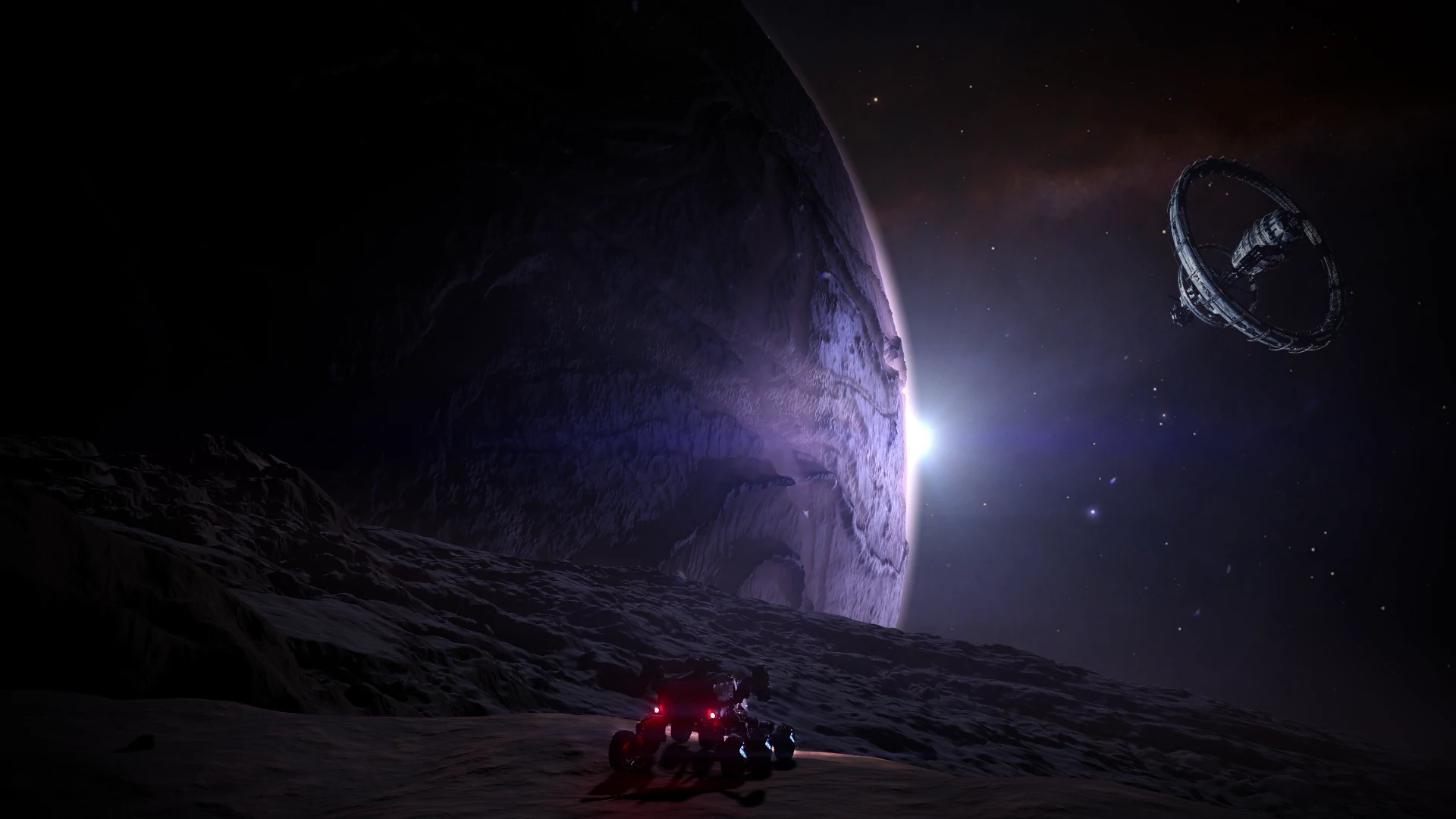
FrontEnd1.webm): the SRV, the planet with the star glaring at its limb, the Milky Way, and the unlit Orbis station at upper right. Elite Dangerous © Frontier Developments plc.Why is this on the AlphaPixel Blog?
The same problem appears in our client work wheelhouse wearing other masks: attitude determination (star trackers, “lost-in-space” solvers), camera resectioning / Perspective-n-Point (PnP) (AR registration, photogrammetry, robotics), navigation without GNSS (vision-based localisation; see our vision navigation overview and toy vision navigation system), image forensics (was this image flipped, cropped, composited, otherwise altered?), and signal processing (frame stacking, noise reduction, image metrics). The Elite Dangerous video game is a perfect laboratory. Its renderer is deterministic, its star catalogue is public (ED uses actual astronomical data and star catalogs, augmented by procedural fillers), and players have published thousands of ground-truth screenshots with known locations. There’s a real-world practical example: in April 2020 NASA’s New Horizons imaged Proxima Centauri and Wolf 359 from about 47 AU and demonstrated interstellar parallax navigation (NASA release, June 2020; the full analysis is Lauer et al. 2025, AJ 170, 22, which fixed the spacecraft’s position to 0.44 AU from the star images alone). So this is our bread-and-butter skillset, my daily bread with a shot of Leestian Evil Juice (a potent in-game liquor, and more game lore).
Getting clean data out of a compressed video [Difficulty Level: Harmless]
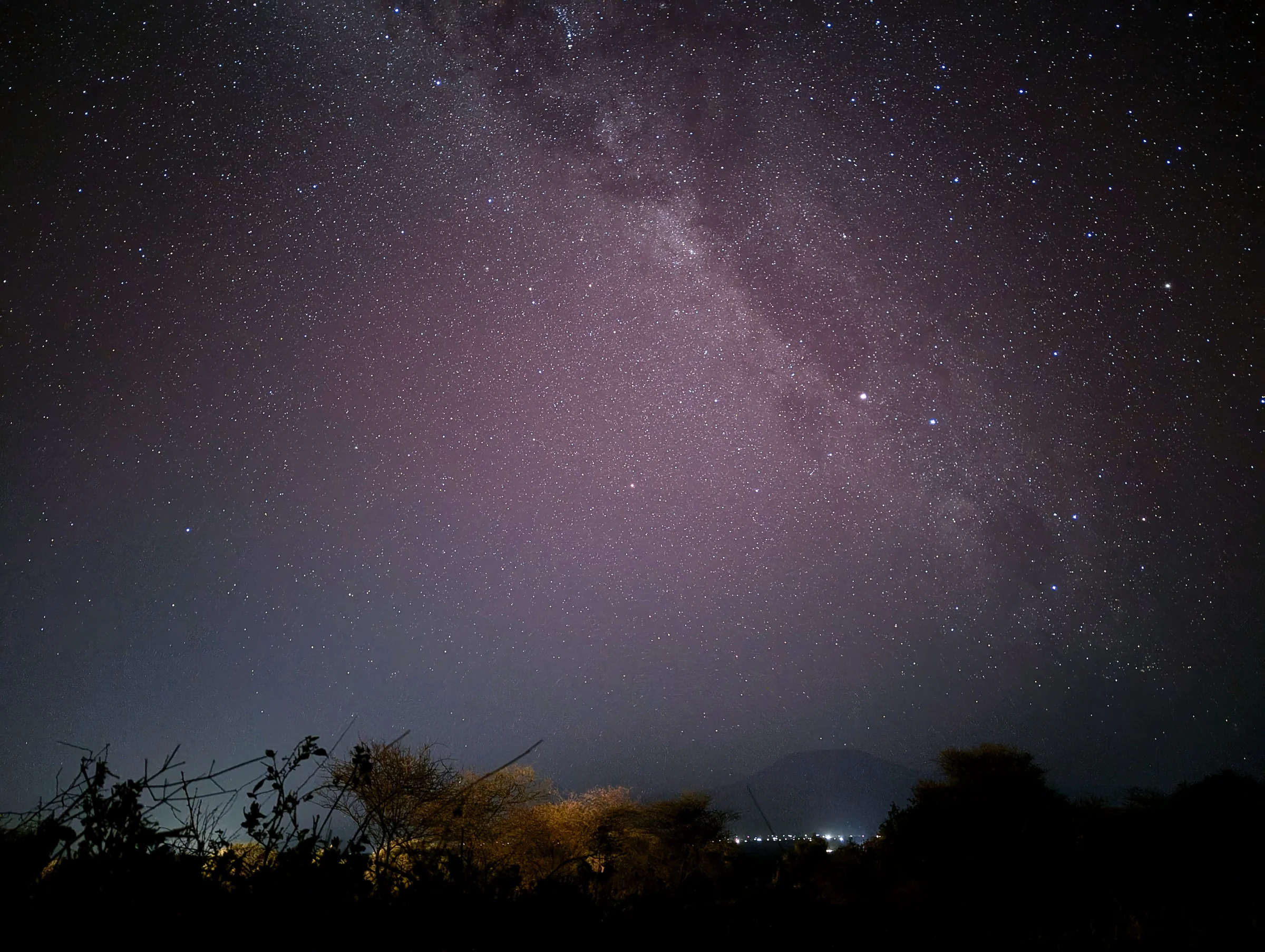
The primary source is ED’s own webm asset, extracted from disk (1920×1080 VP8, 30 fps, 2,699 frames, ~90 s loop; Fig. 1). I started my 3D career doing desktop video and 3D animation, so I’ll comment on this in a film vernacular hybridized with a forensic image analysis dash of spice. The camera is locked off. Only the station rotates (and the SRV lights flicker), so every star pixel is a time series of one value plus codec noise. The station stays mostly in one place except for the arms (and wheel) spinning, so some part of the scene is blocked by it unrecoverably. Obviously the unmoving planet and moon block some of the scene, and the sun and glare obscure some. Frame stacking with median selection can recover the most common pixel value in locations where the station arms SOMETIMES hide the night sky, and improve the SNR and decrease compression artifacting in spots that don’t intentionally change (Fig. 2). This is just like stacking multiple astrophotography frames from a telescope to remove satellites and other brief artifacts and improve the capture of the unmoving stars you want. Here’s a frame-stacking example of my own from Kenya, looking at the night sky over Kilimanjaro (Fig. 3). It’s a phone shot: the Pixel’s Night Sight astrophotography mode takes up to 15 frames of up to 16 seconds each, then aligns and averages them (Google Research, 2019).
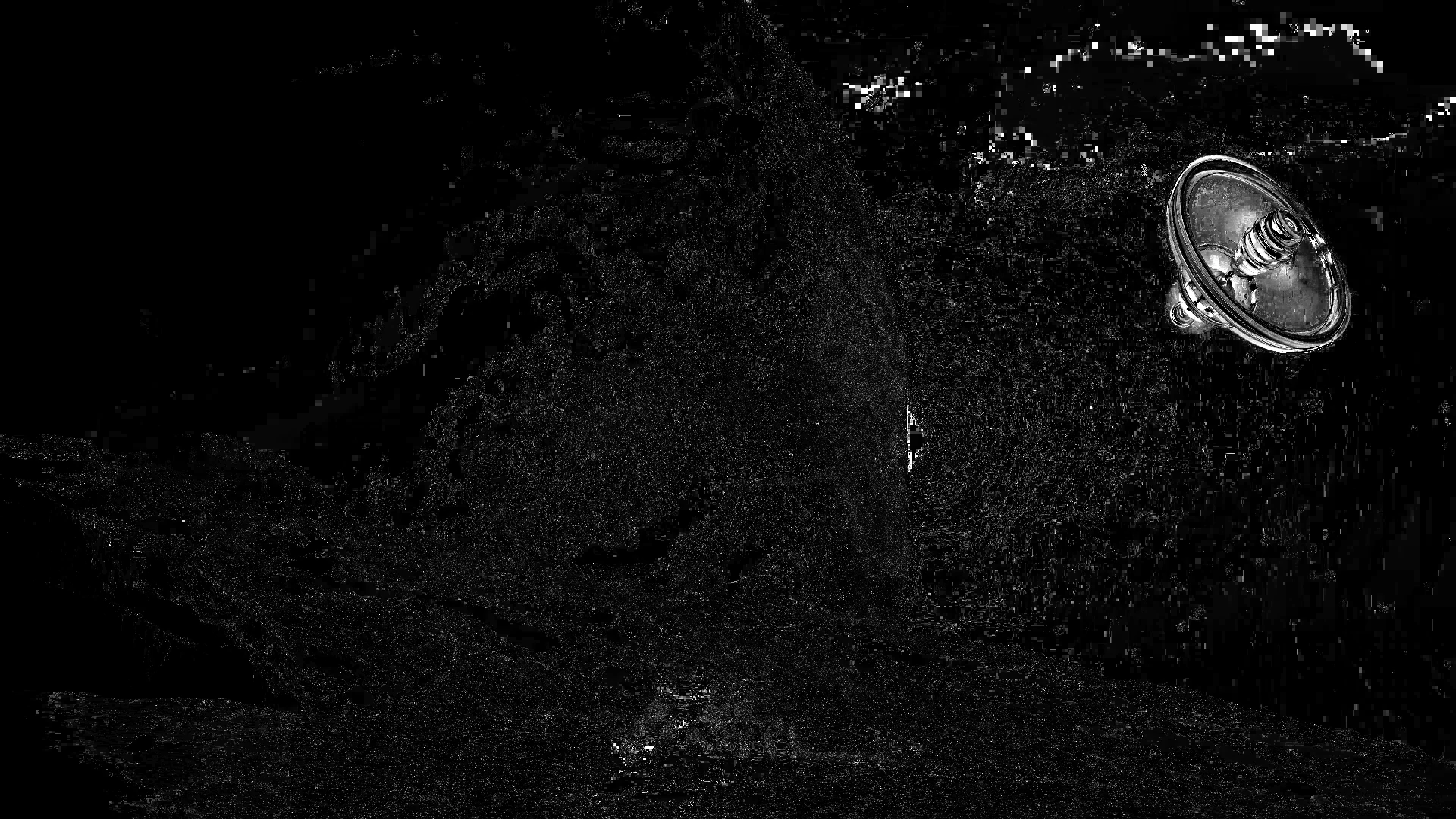
Since the camera doesn’t actually move with respect to the starfield, we can’t exploit super-resolution methods to get sub-pixel data the way you can with untracked or imperfectly tracked astrophotography. The renderer is too perfect to leak any extra detail. We can, however, centroid each star’s point spread function (PSF) to get a sub-pixel star-center location. The renderer draws each star as a small antialiased blob, so this is fabulous for us. VP8 only stores colour at half resolution (4:2:0), so colour is the least reliable star feature, but the geometry is more important anyway.
Sometimes the human brain is the best tool to start with [Difficulty Level: Mostly Harmless]
My original plan was to enlist an army of adventurers to travel the galaxy submitting screenshots of what the galactic cloud looked like, then train a deep learning model on those, with the actual galactic coordinates and possibly camera pose (where is the center of the galaxy, Sagittarius A*, in the image) as output, and then use a second set of test data excluded from the training to see if I could localize arbitrary unknown galactic-disk images. But I was lazy and in a hurry and didn’t want to assemble a new army in 2026, so I did some searches and amassed 40 online screenshots ranging from the core and Colonia to the rim and far off the plane. Auto-exposure and changes in the renderer over time confused this a lot. The whole deep-sky renderer has changed at least a couple of times, and older shots have different amounts of yellow than newer ones. But, subjectively, the closest matches were views toward the core from the inner disk, at the Eagle and Trifid nebulae, about 5,000 to 7,000 ly from Sol. They show a cream band with an amber dust lane just like our candidate. This was kind of exciting, because there totally could be an overlooked system out there.
I tried some real CSI stuff on the cross-band profile, trying to pin something down. There just wasn’t enough to work with in the screengrab, though. And, after looking, I realized that the neighborhood of Sol itself also looked fairly similar. What I COULD tell was where it WASN’T. It wasn’t way out on the rim, or very far off the plane of the galactic disk. So, that’s gotta be worth something. It’s possible that with a much larger dataset of images, my original method would have borne fruit. But as it turns out, it didn’t need to.
After having failed on the first theory, I attempted to reduce the remaining problem space by bisecting it, figuring half of a remaining problem is still better than a whole remaining problem. So my new testable hypothesis was “It is either near Sol (Earth), or not”. If it’s near Sol, it’s a huge exclusion of most of the galaxy. If it’s not, well, we’ve removed a little piece anyway. And the secret sauce is, in the neighborhood of Sol, we can do a test that doesn’t work most other places. That test is called plate solving.
Plate solving does not involve the dinnerware [Difficulty Level: Expert]
Now, plate solving sounds like an exercise you work out before Thanksgiving dinner or a wedding reception. But it’s actually a technique for registering astrophotographic images against a star catalogue, to identify the stars and work out exactly which portion of the sky the camera was pointed at, and how it was oriented, for cataloguing and alignment purposes (Astrometry.net, Lang et al. 2010). Long before GPS, and where LORAN wasn’t an option, the SR-71’s famous astro-inertial navigation system, nicknamed “R2-D2” (Northrop’s NAS-14V2), sighted stars from a 61-star onboard catalogue, day and night, to correct its inertial platform’s heading, attitude and position (collectively, “pose”) at Mach 3+ and 80,000–85,000 ft (SR-71A flight manual, Section IV; Smithsonian; NASA fact sheet). That’s a hardware ancestor of plate solving. We’ve used plate solving ourselves for celestial vision navigation in GPS-denied areas. Fun fact: on Earth you can’t Perspective-n-Point solve your position from the stars alone, because they’re so uniformly far away that their 2D relationship never changes anywhere on Earth you go. Star directions only give you orientation; celestial navigators (and the SR-71) get position by adding the local vertical and an accurate clock.
Here’s what a plate solve looks like on a real photo. My Kilimanjaro shot (Fig. 3) solves against the Hipparcos catalogue with 84 stars matched, 61σ above chance, at about 1 pixel rms (Fig. 4). The solved field of view, 56.3° tall, matches the Pixel 6 Pro’s 24 mm-equivalent main camera, so the solver measured the lens too. That’s the Southern Cross and the Centaurus Pointers (Rigil Kentaurus and Hadar) above the mountain, with Scorpius’ tail at the top.
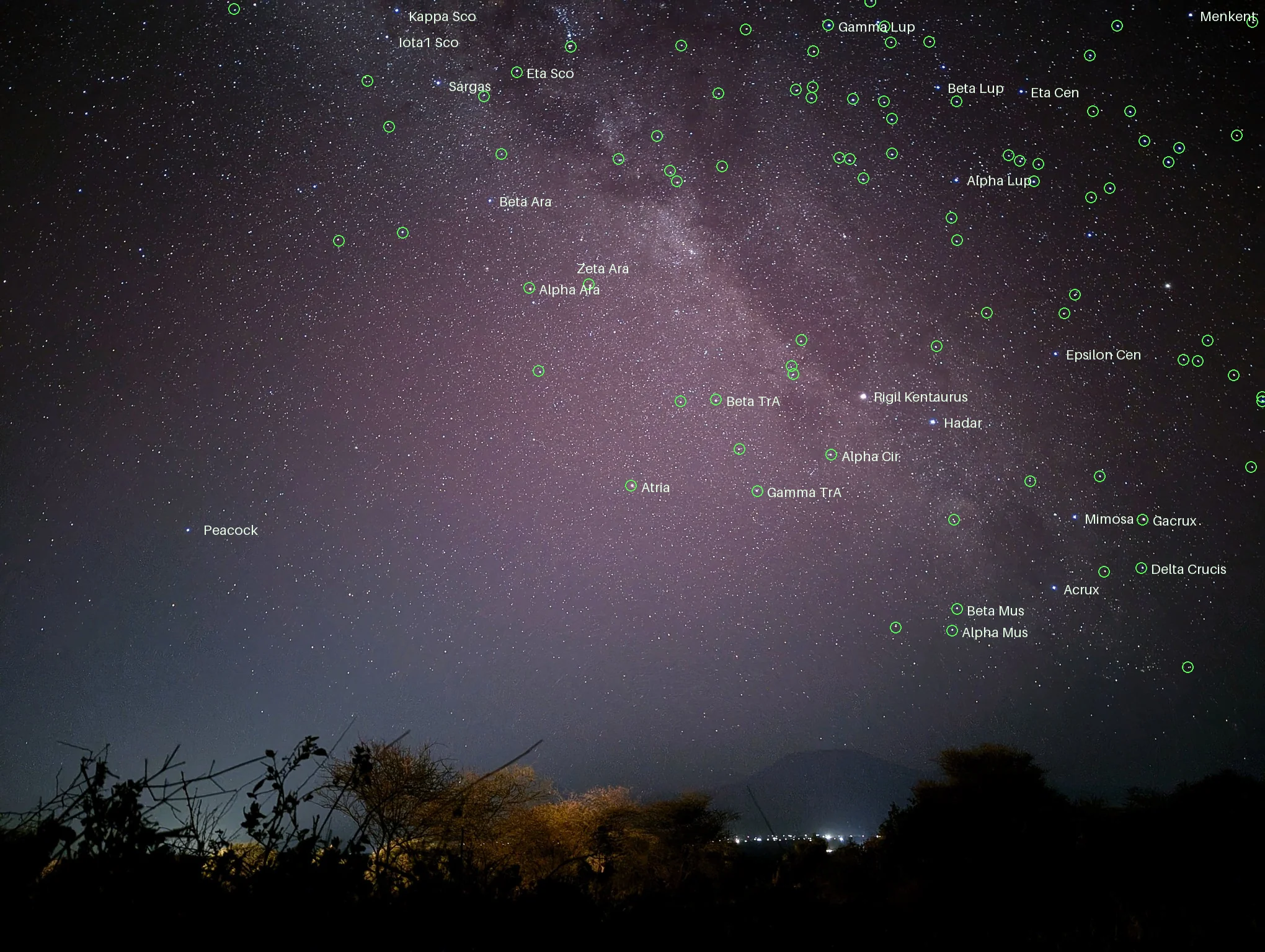
Since Elite Dangerous actually uses real star catalogs like Hipparcos, we can try to actually plate-solve against those databases, which we can download freely. Hipparcos gives us the 3D positions of the stars in galactic space, so if the viewpoint is anywhere near the stars of the Hipparcos catalog, we CAN actually Perspective-n-Point solve for the observer’s position! Sol is about 26,000 ly from the galactic centre in a disk about 100,000 ly across, so the useful Hipparcos volume is a small sphere around us inside the local (Orion) spur. The 2007 Hipparcos catalogue (117,954 stars with positions) has stars out beyond 3,000 ly, but the position precision of the more distant ones is dubious. Only 30,548 stars have distance estimates good to 10%. Half of those are within 280 ly, 90% within 544 ly, and none beyond 2,219 ly. There’s not a sharp cutoff, but within 100 ly of Sol you can be pretty sure you will have a match. There’s a bigger star catalog, Gaia DR3, with about 1.8 billion stars and parallax errors around 0.02–0.1 mas for bright stars, which pushes good distances out to roughly 10,000 ly. But that’s even more work. My motto is fail (or succeed) fast, so I aimed for a 300 ly search area around Sol. “The Bubble” in ED, an area of high player traffic, was about a 200 ly radius sphere-ish area (player colonisation has stretched it since 2025). Colonia, the secondary sphere of activity, is about 22,000 ly away (and about 900 ly below Sol’s level), so outside of this search. (The next step would be to pull data from EDSM/Spansh to plate-solve the whole galaxy, but my computer cried when I thought of that task.)
So, with Hipparcos downloaded, I set about plate-solving for the system housing the pictured dark wheel station (and its odd planet and moon with the SRV).
The core technique is based on Astrometry.net (Lang et al. 2010, AJ 139, 1782), which is kinda the go-to of digital plate solving. Basically, take groups of four stars and hash each group into a code that doesn’t change when the group is moved, rotated or scaled, then look those codes up in an index built from the reference catalogue. There’s a ton of astronomy and geometry here I’m hand-waving, but you can use the cloud-based solver on astrometry.net or download and run it locally yourself. I wrote my own compact version of the approach in Python (NumPy and SciPy), because I knew I’d need to bend it later. I first tested it on ED screenshots taken at Sol, and it worked (Fig. 5).
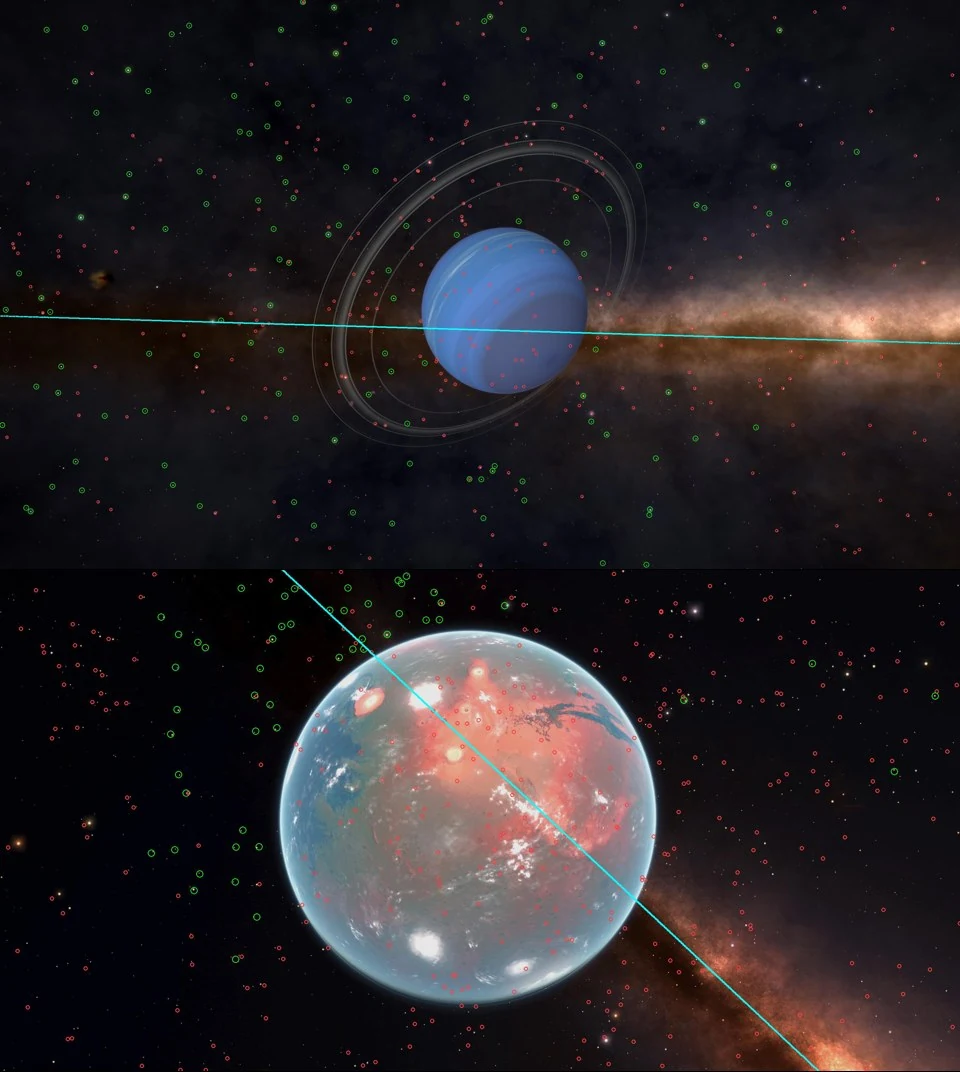
PnP across a 3D star field database [Difficulty Level: Dangerous]
Normal plate solving assumes you know where you are. Moving the observer changes the sky, because nearby stars move and distant stars don’t. So this application of plate solving is a bit novel. Frankly, that’s because we Earthlings haven’t been able to TAKE images with much stellar parallax from anywhere but Earth’s neighbourhood. Even the furthest man-made object from Earth, Voyager 1, is about 16.04 billion miles (25.8 billion km) from Earth, roughly 172.5 astronomical units (AU), as of mid-October 2026, and it reaches one light-day on 18 November 2026 (NASA). To the eye, the view from there is no different from Earth’s: the nearest star, Proxima Centauri, shifts by only about 2 arcminutes, a fifteenth of the Moon’s width. There’s a hairy ton of math to combine plate solving and PnP simultaneously, and I’m not going to make this a 30-page article by trying to publish it. If you want the deets, email me. But, after some messy hacking, the PnP plate solver successfully localized the known Earth/Sol screengrab to within 0.03 ly of Sol, which is about 1,900 AU. Quite a ways outside our system (Pluto travels as far as about 50 AU from the Sun), but still close enough to tell we’re talking about Sol and not Alpha Centauri (4.37 ly, or about 276,000 AU away).
Next I tried hybrid plate-solving a known Alpha Centauri screenshot, at the notorious Hutton Orbital. Have I ever told you about when we Fuel Rat’ted the Hutton run, trying to save a Russian player over IRC using Google Translate? Good times. The plate solver came back within 0.06 ly of the reference, which was good enough for me. So things were looking REALLY promising. Too promising, maybe.
Next, I tried replicating the constraints of the launch screen image: significant occlusion by non-star junk. Could the hybrid plate solver actually still solve? The initial answer was no. After some tuning, I finally got a detection measurably above the noise floor (a score of 12 against noise of 10). More tuning commenced. After final tuning, it was the only candidate above the noise floor. This took about 2 hours of compute time on my laptop using heavy Python.
Test in production [Difficulty Level: Deadly]
So, the next obvious step was to try it on the real data, with some confidence it could actually work. After running the star coordinates from the stacked and cleaned screenshot, the solver completely failed to find a match.
Back to the drawing board. It was at this point that something in the back of my mind reminded me that people had long speculated about weirdness in the composition of the image (I said so myself in 2019, and others pointed out the orbits made no sense). You see, in ED, there are rules about orbits and placement, and the arrangement of the star, planet, moon and station didn’t seem to meet the normal requirements. So we suspected it was artistically composed, and not “anatomically correct”. So, some shenanigans might have been applied for artistic reasons. Like, maybe a transform for composition reasons. Like when you’re watching a commercial or movie and realize the scene is backwards because the art director liked the hero subject on the right instead of the left and just flipped it in post, but didn’t notice that the Starbucks logo now says ꙅʞɔudɿɒtƧ.
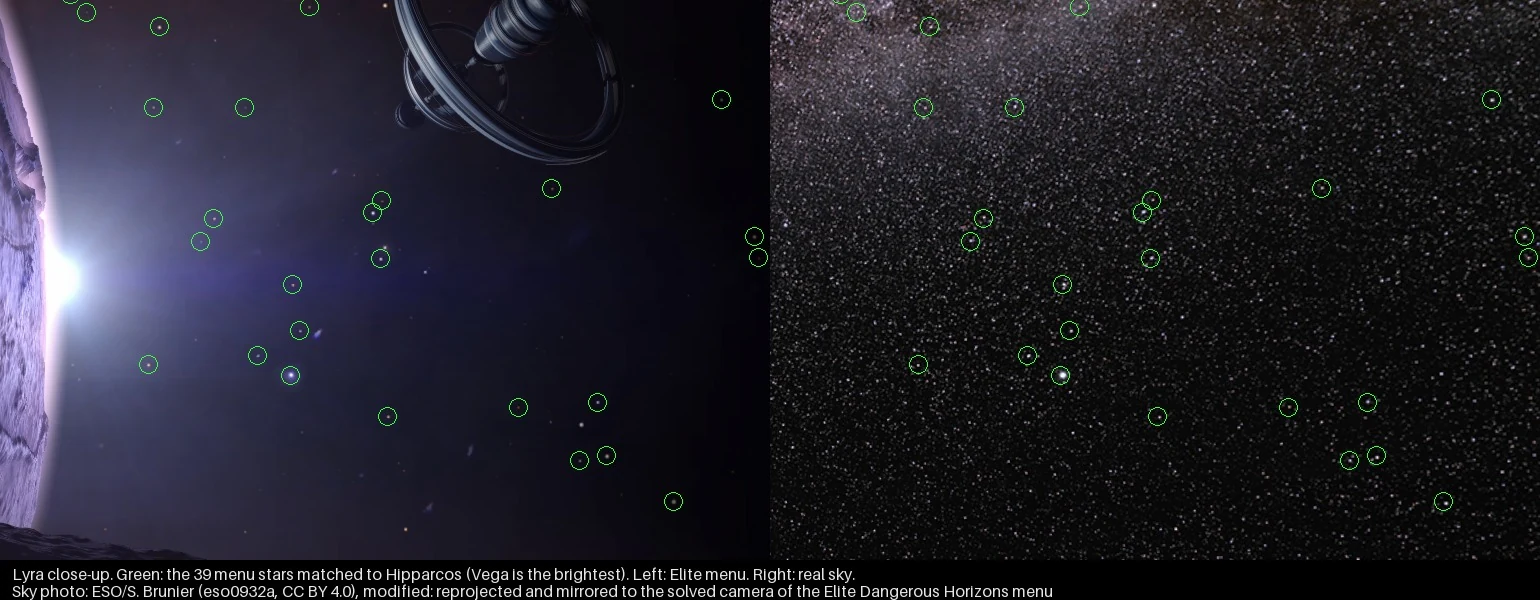
So, I tried flipping the candidate screengrab left to right. (That’s the only flip that matters: an upside-down flip is the same thing turned 180°, and the solver already handles rotation.) And lo and behold, it solved (Fig. 6). It was also able to compute some other malarkey that had made the original searches struggle: the camera’s optical center isn’t in the middle of the frame.
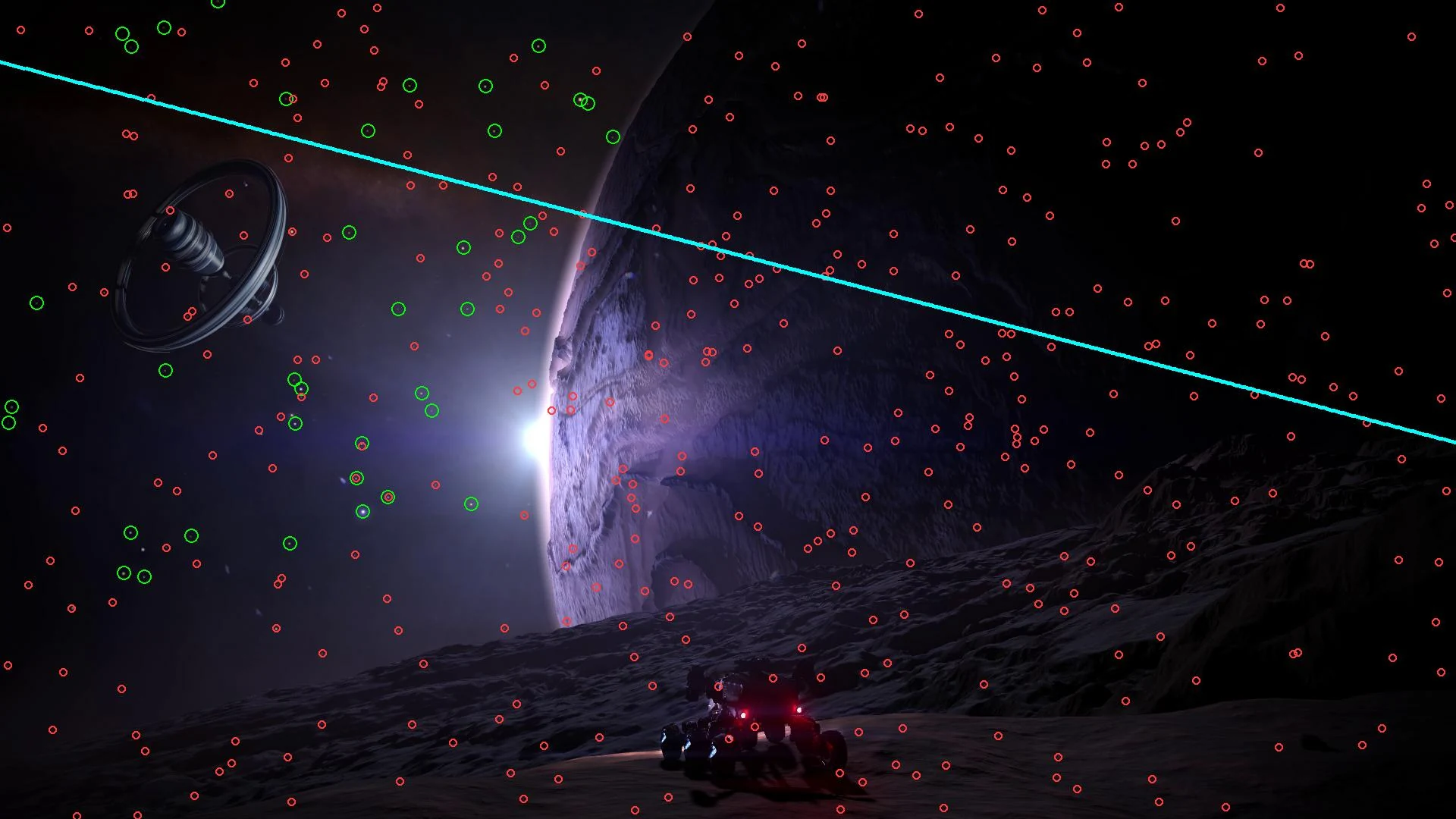
But let’s jump to the big reveal! What system is the pictured Dark Wheel station in?
The Big Reveal [Difficulty Level: Elite]
Sol. It’s pictured in Sol. Earth’s system.
Using 39 matched stars, the boresight is RA 289.2°, Dec +57.8° (galactic l 88.8°, b +19.5°), looking toward Lyra, Cygnus and Draco (Fig. 7). The PnP resolves to about 0.04 ly from Sol (basically slop in the process math). The principal point is at (914, 765), about 225 pixels below the frame center. That suggests an artistic off-center crop as well as a horizontal flip. Funny thing: Astrometry.net itself tries both mirror images by default (solve-field’s --parity option, default “try both”) and doesn’t assume the reference point is the image center. My home-grown solver got both of those wrong. I’d built it to reject reflections, because the real sky never mirrors itself, and my fast position search assumed a centered camera. Lesson learned.
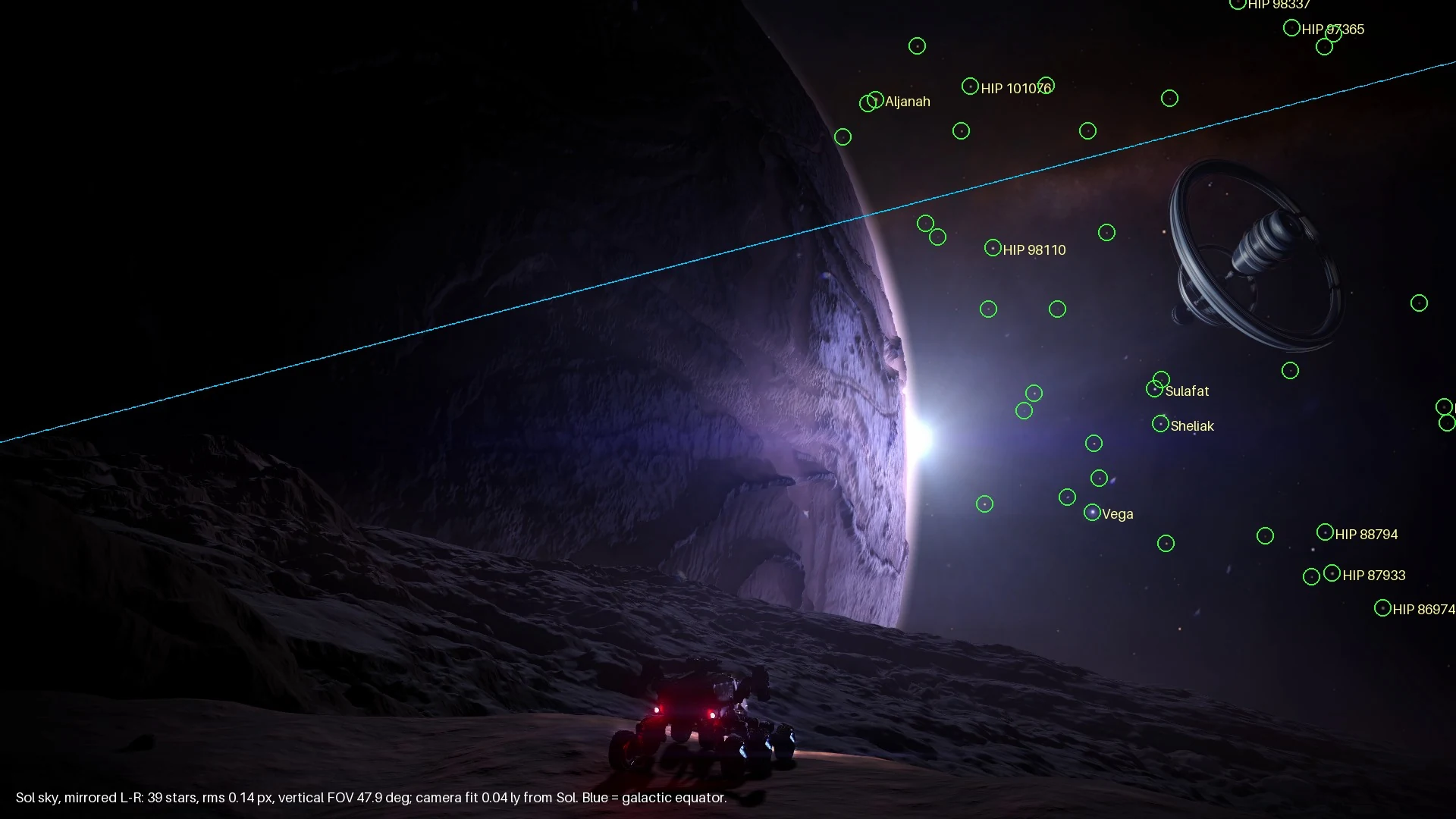
A fun aside: my Kilimanjaro photo (Fig. 4) looks almost the opposite way. When I took it, Vega was 109° away, behind me in the northern sky.
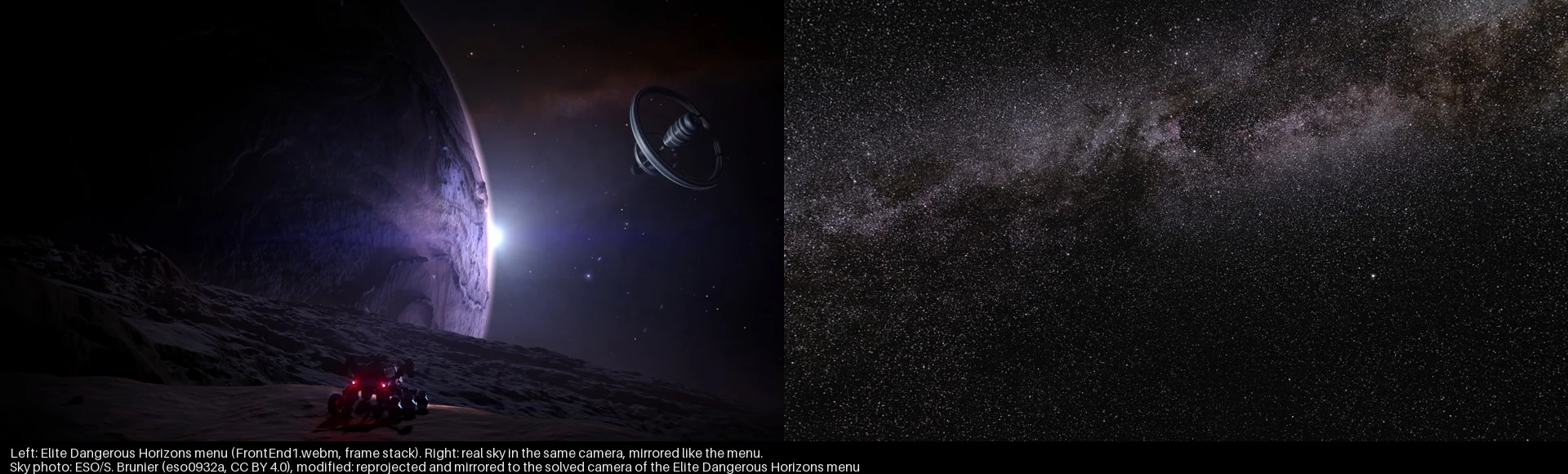
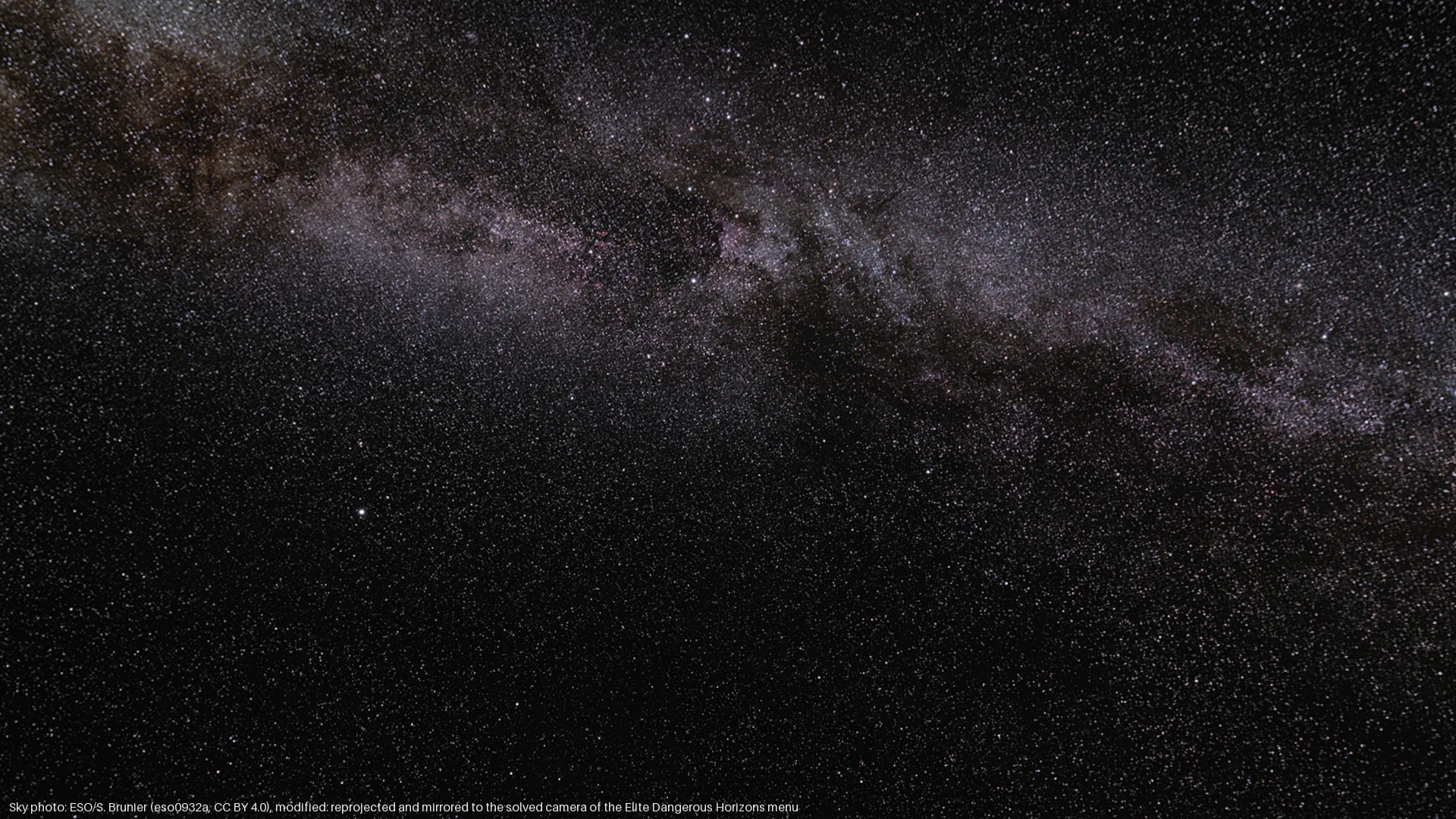
There’s an independent check, too. The galactic equator computed from the star solution runs right along the bright ridge of the Milky Way band (Fig. 8). The band comes from the game’s skybox renderer and the points come from the star catalogue, so the two don’t depend on each other.
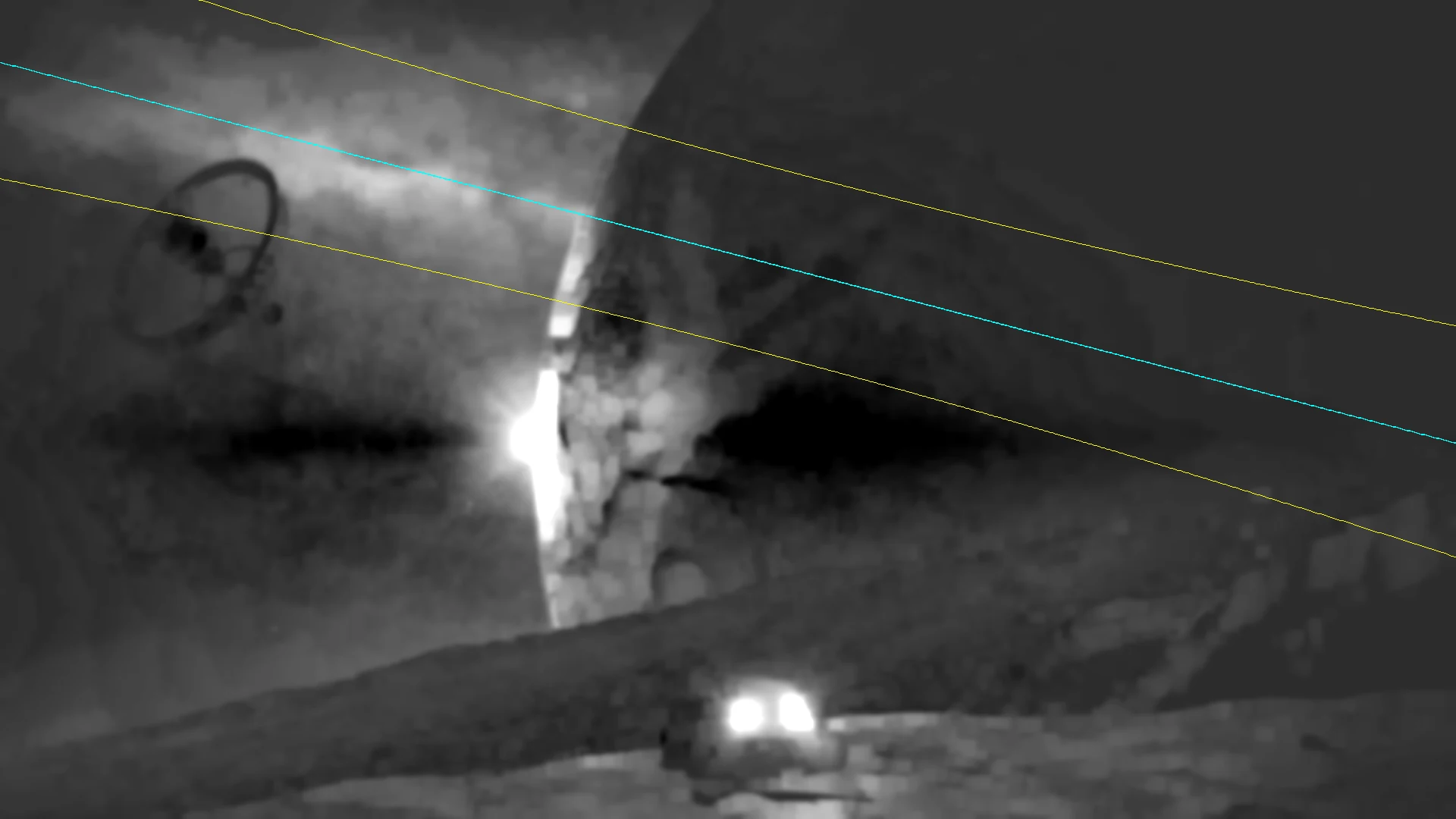
Knowing this, we can now refer to known terrestrial photography for verification. A good candidate image for this is ESO’s “The Milky Way panorama” (eso0932a), by Serge Brunier, photographed mainly from ESO’s La Silla and Paranal observatories in Chile, plus La Palma for the northern sky, with a Nikon D3 on an equatorial mount: nearly 1,200 six-minute exposures between August 2008 and February 2009 (ESO release eso0932). CC BY 4.0, credit ESO/S. Brunier. The panorama is approximately plate carrée in galactic coordinates. I reprojected it into the solved menu camera, corrected the panorama’s small stitching warp against Hipparcos stars (0.89 px rms), and mirrored it like the menu.
Dude, where’s my Dark Wheel? [Difficulty Level: Pathfinder]
The splash/menu starfield is the sky as seen from Sol, viewed toward Lyra and Cygnus, mirrored left-to-right in post-production and cropped off-center. Elite Dangerous computes a different sky for every system. So either the scene was staged in the Sol system using development code, or it’s completely alpha composited from multiple disparate layers (planet/moon/SRV/Sun) + starfield. There’s no secret message to be extracted here. Just art direction.
To quote the immortal words of Chris Knight and Lazlo Hollyfeld from Real Genius (1985):
Lazlo Hollyfeld: How’d you do?
Chris Knight: I passed! But I failed!
Lazlo Hollyfeld: Well, then I’m happy and sad for you.
I succeeded, but I failed. And I am happy, but sad.
Vision navigation lessons learned [Difficulty Level: Pioneer]
Oh, there’s a lot. So many assumptions that turned out not to work. So many axioms I thought I could rely on that I couldn’t. And in the end, no Dark Wheel or Raxxla. Maybe the real Raxxla was the friends we made along the way.
It’s cheap to test cardinal image transforms, so if there’s any chance, it’s worth doing. Likewise, you can’t always count on the principal point being in the center. I worked once with a six-figure camera gimbal that was boresighted when zoomed out but horribly off-axis when zoomed in. The camera couldn’t be replaced or fixed, so we had to compensate for it in software. Write lots of bidirectional tests to prove you can succeed, and to know in advance when you’re failing. Be aware of the noise floor/ceiling. Failing doesn’t mean failing if you wouldn’t have been able to detect a success anyway. Question everything. My original idea of machine-learning image matching turned out to be way overkill, and was bypassed by simply looking at the candidate images and realizing they already told me quite a bit. Enough to move on to a more quantitative and mathematical discrete analysis without training a deep learning network at all.
Where do we go from here? Which is the way that’s clear? [Difficulty Level: Tycoon]
Well, this was a bust as far as locating The Dark Wheel and Raxxla, but it was a huge success in vision navigation experimentation in a 3D celestial navigation context.
I feel a bit stupid for never considering the easy answer right up front, but I doubt I would have casually recognized Sol’s stars by eye, especially mirrored. Perhaps a professional astronomer would have, but as an amateur, I didn’t. Also, I was pretty sure it was some remote and overlooked system, so it didn’t even occur to me it was just a rigged demo.
I haven’t played Elite Dangerous in a while. I don’t have any other leads on The Dark Wheel right now, but I’m going to keep researching what has happened and what is known since I’ve been away, and might do some other non-computer-vision game lore data analysis following this, and might see you out there in the void again sometime. If you ever see an Anaconda named the Istari wearing a gorgeous founders’ paint scheme you’ve never seen before, give me a wave. o7 CMDRs, from CMDR XenonOfArcticus.
AlphaPixel does computer vision, photogrammetry, sensor fusion, space domain and graphics work: pose estimation, calibration, image forensics, and making old or odd data talk. We solve difficult problems (like this one) that nobody else does.
Elite Dangerous is a trademark of Frontier Developments plc. Game images are © Frontier Developments plc and are used here for commentary and analysis. AlphaPixel is not affiliated with or endorsed by Frontier.

