
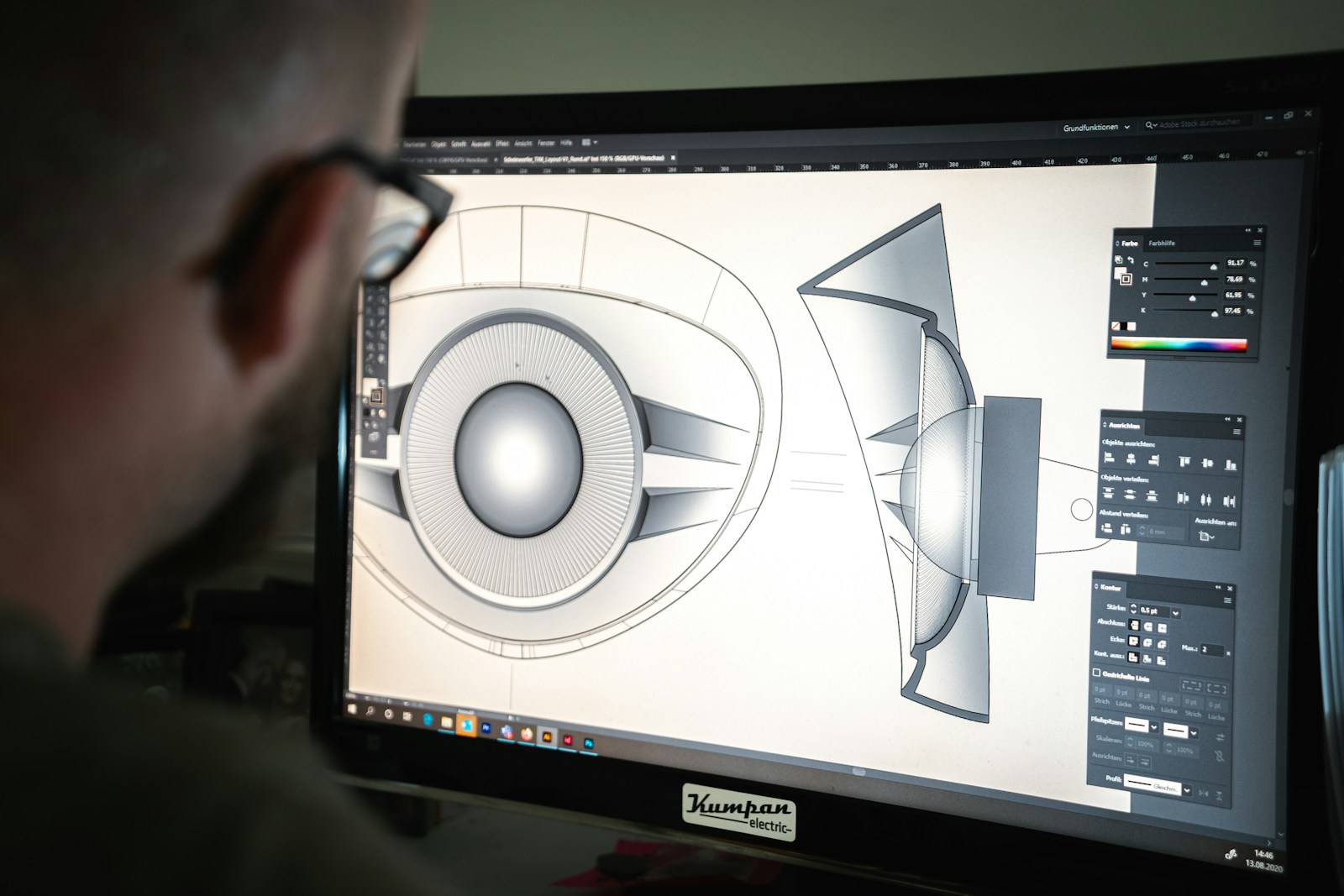
We have been writing CAD software since it barely fit on the machines of the day. We started trying to make 2D and 3D CAD run on Commodore 64s and Amigas in the 1980s, and we have been at it through every generation of hardware since. We also do not just write the software: we run the machines. We are fabrication people who print, cut, and mill our own parts, so we understand CAD from the first sketch all the way to the chips on the shop floor.
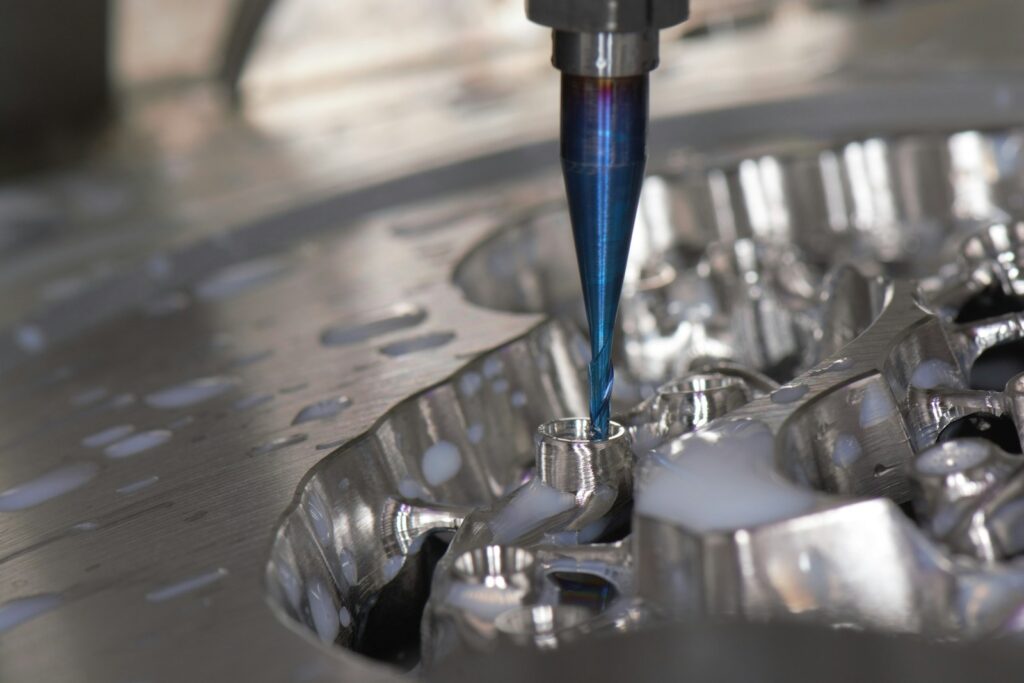
Photo by nik biziuk on Unsplash.
Four decades of CAD
- In the 1980s we were writing 2D and 3D CAD code on Commodore 64 and Amiga hardware, back when fitting a modeler and its data into a few or few hundred kilobytes was the biggest problem.
- In 1989 we cut our teeth on custom sheet-metal duct software on a MicroVAX, the kind that lays out and unfolds ductwork into the flat patterns we printed that a shop can actually cut.
- In the early 1990s we worked on Progressive Peripherals and Software's 3D Professional and UltraDesign on the Amiga: 3D modeling and rendering and 2D drafting for a platform that was FAR ahead of its time.
- We worked on MakeVR, a virtual-reality CAD and design tool, modeling with your hands in 3D space instead of pushing a mouse across a flat desk. That work connects to our VR, AR, and xR practice.
- We have expertise in CSG, SolidWorks and in OpenSCAD and the open parametric-modeling ecosystem, where the model is manifested as code and the geometry is driven by constraints.
Modeling, from freehand to parametric
We work across the ways geometry actually gets represented: boundary-representation solids, meshes, and parametric, constraint-driven models where a change to one dimension ripples through the whole part (hopefully) correctly. We move data between the formats the field really uses, including STEP, IGES, STL, DXF, OBJ, 3MF, and 3D PDF. We wrote and improved file support modules for Okino's PolyTrans. We repair the broken meshes and non-manifold geometry that real files are full of as seen in LGM's CADSpan, a tool we worked on that turns messy CAD into the clean, watertight STL a 3D printer needs. Sheet-metal unfolding and flat-pattern nesting, boolean operations, and the geometry processing underneath all of it are the same 3D graphics craft we bring to everything else.
Scan to CAD, and reverse engineering
Often the part exists before the model does. We turn real objects into editable geometry using computer vision: photogrammetry, structured-light and depth sensors, point clouds, and newer radiance-field methods like Gaussian splats and NeRFs that reconstruct a scene and hand it to a mesh. Getting from a noisy scan to clean, watertight, dimensionally honest CAD is a hard problem, we do it.
CAM, toolpaths, and G-Code
This is where a lot of software people stop and we keep going, because we understand the fabrication side by living it. Additive processes like FDM, SLA, and SLS, and subtractive ones on CNC mills, lathes, routers, lasers, plasma, and waterjet. That means toolpath generation and CAM, slicers and post-processors, feeds and speeds, fixturing and work-holding, and the G-Code that actually drives the machine. When your CAD has to end up as a physical part, the pipeline from model to toolpath to finished piece is one we have walked end to end, with all the obstacles along the way.
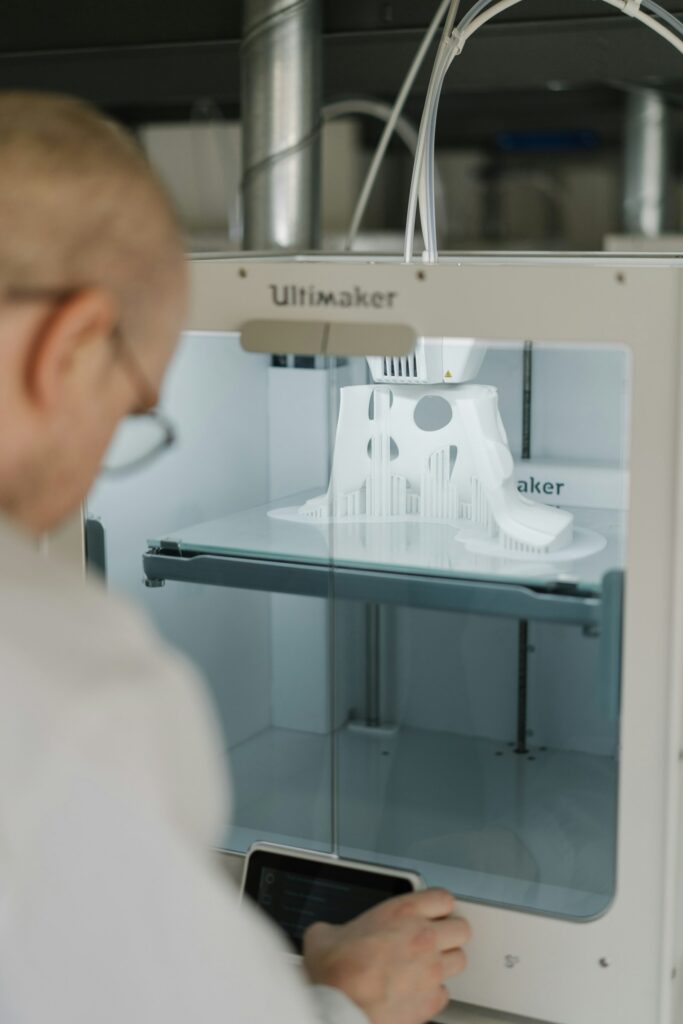
Photo by Tom Claes on Unsplash.
Visualizing and driving CAD
Big assemblies and digital twins have to be drawn fast and correctly. CAD visualization has been an OpenSceneGraph stronghold for decades, and we build the large-model rendering, inspection, and visual-simulation tie-ins that put a CAD model into a live, interactive context rather than a static viewport. We did extensive CAD simplification and optimization inside the open-source OSGWorks library, work funded by the Department of Energy through Iowa State University, so heavy assemblies stay fast enough to inspect and manipulate.
Who works on it
AlphaPixel is a US-owned small business, founded in 2004, with senior developers who have written CAD and modeling software since the 1980s and who fabricate their own parts, additive and subtractive. DLA DD2345 / ITAR registered. We take closed-source defense work and open source alike, and we do not sell a CAD package, so our advice is not a sales pitch for one.
Frequently asked questions
What CAD and CAM software work do you do?
We have written CAD software since it barely fit on the machines of the day, starting on Commodore 64 and Amiga hardware in the 1980s and continuing through every generation since. We also run the machines: we print, cut, and mill our own parts, so we understand the whole pipeline from the first sketch to the chips on the shop floor.
What CAD file formats do you support and convert between?
We move data between the formats the field really uses, including STEP, IGES, STL, DXF, OBJ, 3MF, and 3D PDF. We have written and improved file-support modules for a commercial 3D data translation product, so format interchange is core work, not an afterthought.
Can you repair broken meshes and non-manifold geometry for 3D printing?
Yes. Real files are full of broken meshes and non-manifold geometry, and we repair them. That is the kind of work behind a commercial STL-cleanup tool we helped build, turning messy CAD into the clean, watertight STL a 3D printer needs.
Do you do scan-to-CAD and reverse engineering?
Yes. Often the part exists but a model doesn't, so we turn real objects into editable geometry using computer vision: photogrammetry, structured-light and depth sensors, point clouds, and newer radiance-field methods like Gaussian splats and NeRFs. Getting from a noisy scan to clean, watertight, dimensionally honest CAD is a hard problem, and we do it.
Do you write CAM, toolpaths, and G-Code, or only CAD?
Both. We understand the fabrication side by living it, across additive processes like FDM, SLA, and SLS and subtractive ones on CNC mills, lathes, routers, lasers, plasma, and waterjet. That means toolpath generation and CAM, slicers and post-processors, feeds and speeds, fixturing and work-holding, and the G-Code that actually drives the machine.
Can you visualize and drive large CAD assemblies and digital twins?
Yes. Big assemblies and digital twins have to be drawn fast and correctly, and CAD visualization has been an OpenSceneGraph stronghold for decades. We built large-model rendering, inspection, and visual-simulation tie-ins, and we did extensive CAD simplification and optimization inside the open-source OSGWorks library (funded by the Department of Energy through Iowa State University) so heavy assemblies stay fast enough to inspect and manipulate.
Do you work with parametric and code-driven CAD like OpenSCAD and SolidWorks?
Yes. We work across boundary-representation solids, meshes, and parametric constraint-driven models where a change to one dimension ripples through the whole part, and we have expertise in CSG, SolidWorks, and the OpenSCAD open parametric-modeling ecosystem where the geometry is driven by code and constraints.
How do we engage AlphaPixel for a CAD or fabrication software project?
Tell us where in the pipeline you need us, from format translation and mesh repair to CAM, toolpaths, or large-assembly visualization. We are a US-owned small business, DD2345 and ITAR registered, and we do not sell a CAD package, so our advice is not a pitch for one. Contact us to scope it.