
Most of our work reaches a government program indirectly. We are rarely the name on the contract. We are the specialists a prime, a systems integrator, or a national-lab-funded university team brings in to solve the hard graphics, vision, or simulation problem that was holding a program up. We are a US-owned small business, DLA DD2345 and ITAR registered, and comfortable with closed-source and export-controlled work.
How we work with government
We work the way a deep specialist should: as a subcontractor, a team-augmentation partner, or the hired brain for one hard piece, not as a general body shop. Primes and integrators bring us in when a program needs someone who has actually shipped real-time 3D, computer vision, or visual simulation, and needs it done right the first time. Because we do not sell a platform or a product, our advice is not steering you toward our own catalog. Because we are small and senior, you get the people who solve the problem rather than a layer of management over junior staff.
Programs we have contributed to
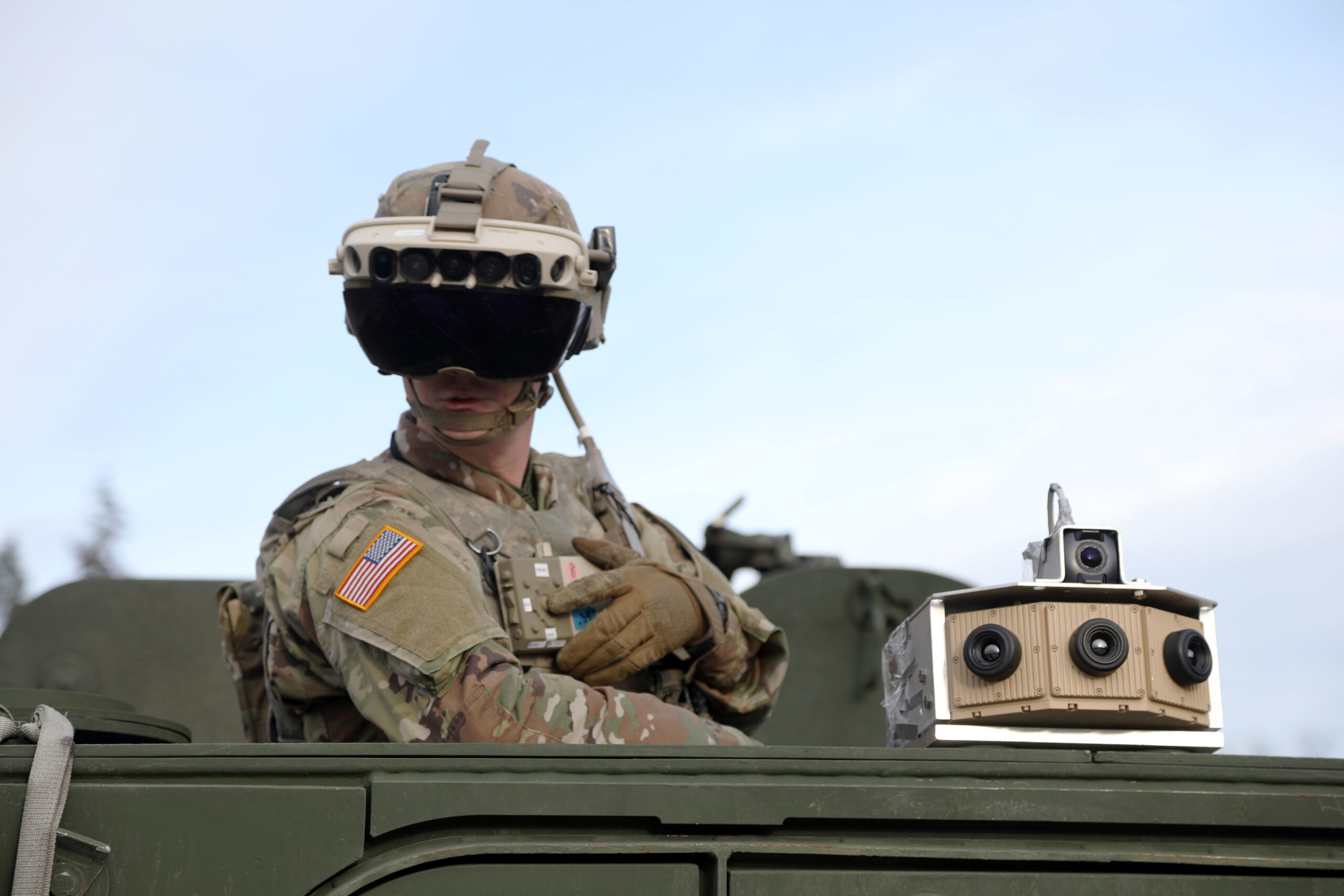
- US Army. We put OpenSceneGraph on HoloLens for the US Army's IVAS mixed-reality program, built the operator interface for the GEARS autonomous ground-vehicle program, and have contributed to immersive augmented-reality training for soldiers. This is the visual simulation and VR, AR, and xR work the Army actually fields.
- NASA. We have built lunar-landing simulation for the commercial lunar payload (CLPS) effort and on-orbit visualization for space domain awareness, planetary-scale rendering where the math has to be right.
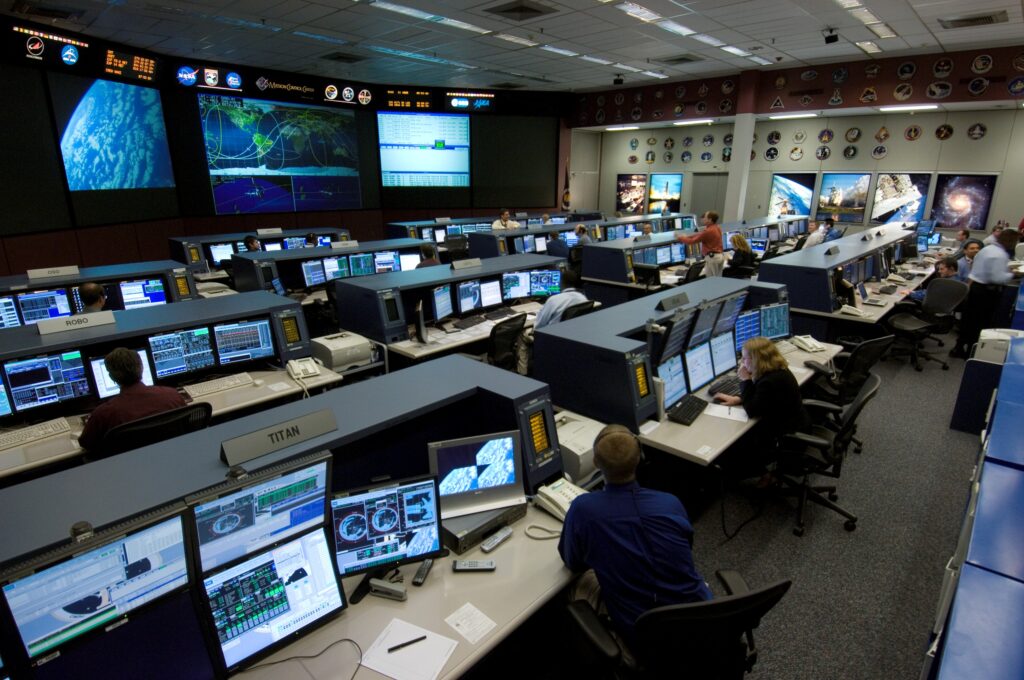
NASA flight controllers in the ISS Flight Control Room, Johnson Space Center. NASA / Robert Markowitz (public domain).
- Department of Energy. We did extensive CAD simplification and optimization inside the open-source OSGWorks library, funded through Iowa State University, and we have built CAD, forensics, imaging, and subsurface-energy visualization for a Department of Energy national laboratory. That is our CAD and 3D graphics craft applied to government science.
- The defense and aerospace industrial base. Through primes and integrators we have contributed orbital situational awareness and MIL-STD-2525 symbology (our Nobori toolkit), synthetic-aperture-radar analysis, airborne terrain and synthetic vision, holographic and plenoptic display demonstrators, and safety-critical glass-cockpit rendering.
Why a small specialist fits government work
Government programs are full of hard, narrow problems a large prime would rather subcontract than staff. That is exactly where we live. We hold DLA DD2345 and ITAR registration, we work in open and closed-source codebases, and we are used to the constraints that come with export-controlled and mission-critical software. When the graphics, the vision, or the simulation is the part that has to work, we are who gets called.
Who works on it
AlphaPixel is a US-owned small business, founded in 2004, with senior developers who each have decades in real-time 3D, computer vision, and simulation. DLA DD2345 / ITAR registered. We take closed-source defense work and open source alike, and we do not sell a product, so our advice is not a sales pitch for one.