
LAN-LOK: The Antarctic DOS Sabotage Game Lost for 34 Years (Part 1)
An exercise in reconstructing (and maybe modernizing) history.
AlphaPixel often gets called upon to work on legacy codebases, sometimes VERY legacy. We have contact with code from the 80s and 90s on a regular basis, in a variety of dialects and languages, and stored and archived in various difficult containers and mediums.
While NDAs and confidentiality mean we often can’t talk about our paid projects, we recently had an interesting side project that used the same processes, only it was all for fun, so we can talk all about it.
The task: Revive the only known Antarctic-native game, LAN-LOK.
May 2025: Now archived and playable in-browser via emulation at Archive.org: https://archive.org/details/Lanlok
Introduction
LAN-LOK is a small but remarkable piece of digital history: a DOS game written at Palmer Station, Antarctica in early 1991. Created after the installation of the station’s first peer-to-peer local area network (PalmerLAN), the game captures - through humor, satire, and surprisingly accurate mechanics - the daily realities of early LAN administration in one of the most isolated research communities on Earth.
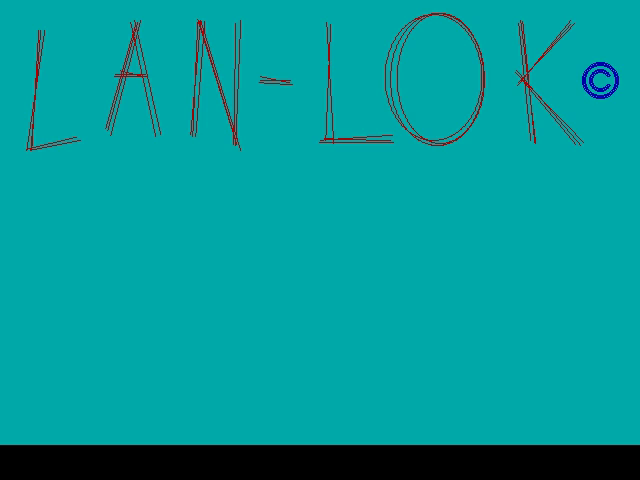
For more than three decades LAN-LOK remained essentially unknown outside the U.S. Antarctic Program. It never appeared on bulletin boards, never circulated as shareware, and left no trace in public software archives or early web indexes. The only surviving evidence was the executable itself, player score data, and the memories of the people who lived and worked at Palmer and McMurdo Stations during the early 1990s.
AlphaPixel founders Chris and Mindy Hanson worked in McMurdo in the 1994 season, and Chris was exposed to and played LAK-LOK via the InfoSys department's culture. Years later, he discovered a copy of it still intact and archived it for later entertainment. In 2025, while doing file organization on the archives, he noticed it again, and decided to try to recover and run it. He attempted to contact anyone who still remembered it through social media, and failed (outside of the few people he worked with who introduced him to it in McMurdo). Finally, he contacted Al Oxton ("ajo"), the central character-nemesis of LAN-LOK, who confirmed a few of the details.
Though “Evil Al” appears as the antagonist inside the game, Oxton had no role in its development. Instead, he recalls LAN-LOK simply as a popular diversion created by “one of the beakers” (Antarctic slang for research scientists) during the chaotic rollout of the station’s first LAN. The title screen credits the actual authors Mark Chappell and Shane Maloney and provides a precise timestamp: “Developed at Palmer Station, February–March 1991.” February-March is typically station closing at the end of the summer season, so Mark and Shane may have been Palmer winter-over reserchers.
This rediscovery positions LAN-LOK as one of the very few verifiable examples of Antarctic-native-born software: a game written in and shaped entirely by the machines, people, and degraded sanity of a remote research base at the dawn of its digital era. Below, we will document what is known about LAN-LOK, and in later blog posts we may attempt to decompile, update and modernize LAN-LOK straight from the 16-bit DOS execuatble, no source is currently available.
Origins at Palmer Station (February–March 1991)
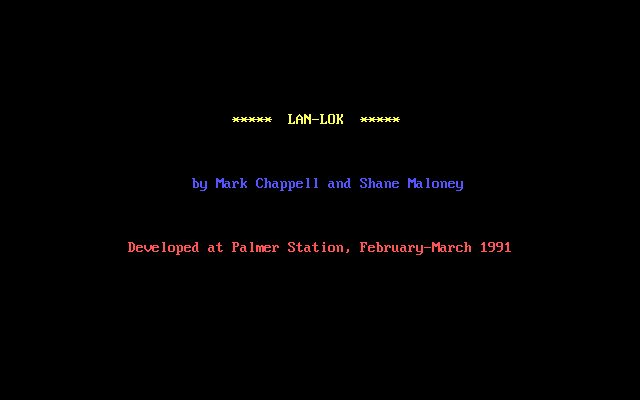
LAN-LOK was created in a very specific technical and cultural moment at the United States' Palmer Station, Antarctica research station, during the late austral summer or early winter season of 1991. The station had recently deployed its peer-to-peer local area network, referred to at various points as GrapeVine and PalmerLAN. It was in this transitional environment that two researchers Mark Chappell and Shane Maloney developed LAN-LOK. Their names, along with precise creation dates, appear on the game’s startup splash screen:
“by Mark Chappell and Shane Maloney Developed at Palmer Station, February–March 1991.”
Additional confirmation comes from an email reply I received from Al Oxton, one of the Palmer crew and the real-life inspiration for the in-game antagonist “Evil Al.”
Tue, Dec 9, 2025
The game was written at Palmer by one of the beakers about the time we were installing the first peer2peer network. GrapeVine. PalmerLan. The name of the author of the LAN-LOK code is in the startup splash and in the code: "by Mark Chappell and Shane Maloney...Developed at Palmer Station, February-March 1991". The game was popular but that is all the backstorey I can come up with. Some of the names in the PLAYERS copy I have sort of indicate I took the game to McMurdo for my last Winter(s) there: Carl, Wendy, Sliz... I've not played LAN-LOK for years
The technical context of Palmer Station in 1991 shaped the game’s tone and mechanics. The introduction of a shared network brought new challenges, printer lockups, shared-resource contention, confusing DOS prompts, and occasional catastrophic user errors. These frustrations were quickly turned into humor, and LAN-LOK became a playful/painful reflection of the station’s growing pains as it moved into a more connected era.
LAN-LOK was not simply a pastime but a product of its moment: a locally-written game that passionately captured the experience of building a network at the end of the world, created by the strung out people living it.
The Game’s Concept and Humor
At its core, LAN-LOK is a competitive race between sabotage and repair.
You, the player, are the saboteur. Your goal is to “crash the network” by disabling as many machines as possible in five minutes. The AI-controlled “Evil Al” is the fixer, constantly working through a queue of broken systems and bringing them back online. Every time you take a machine down, you gain points; every time Al restores one, you lose ground. The entire game is built around this tug-of-war.
Mechanically, the loop is:
- Choose a target by typing its real hostname (e.g.,
lab,Calvin,library,Hobbs). - Choose an attack method:
- “Soft” attacks that lock the LAN (print spam, abusive mail).
- “Hard” attacks that delete directories (
del *.*) or reformat drives (format c:).
- Watch Evil Al work through your damage, undoing your work as quickly as he can.
The humor is dark and very sysadmin-specific. Every “attack” mirrors a real DOS-era failure mode: jammed printers, misaddressed email, dangerous wildcard deletes, and the nightmare of formatting the wrong disk. The twist is that LAN-LOK explicitly rewards what sysadmins dread: users who manage to do the worst possible thing in the shortest amount of time.
The joke is sharpened by the hostnames and characters:
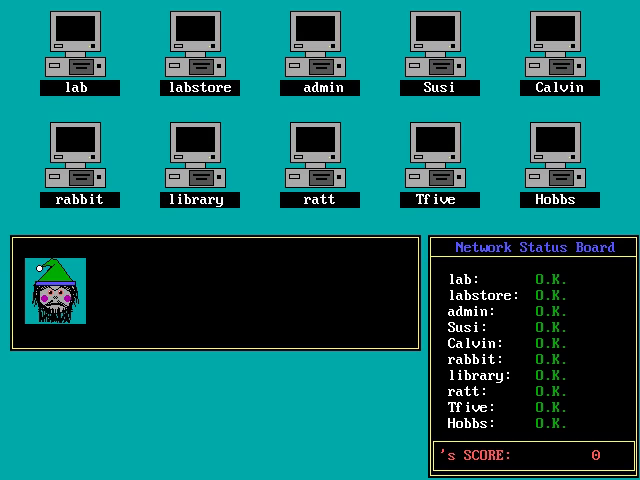
- The network map shows actual Palmer machines with whimsical names like
Calvin,Hobbs,rabbit,Susi, andTfive. - Your own workstation,
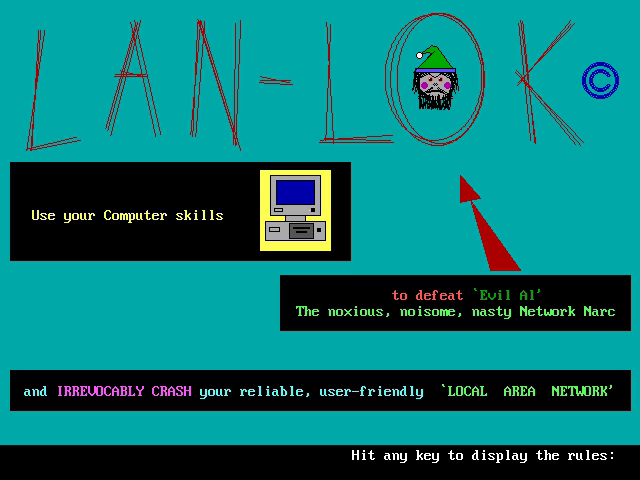
SKUA, is off-limits; nuking it is an automatic loss. - Evil Al’s portrait, bearded, slightly manic, in knit cap, is a caricature of the real Al Oxton, the network wizard who, in real life, spent his time preventing exactly this kind of chaos.
The result is a very specific kind of Antarctic gallows humor: the people who depend on the LAN most are the ones gleefully role-playing its destruction. Anyone who has ever sysadmin'ed knows this is an only slightly-fractured looking glass.
The Origins and Descendants of the Break/Fix Game Mechanic
Twenty-one years after LAN-LOK, Disney’s Wreck-It Ralph (2012) introduced the fictional arcade game Fix-It Felix Jr. In that game, the villain Ralph smashes the windows of an apartment building, and the player, controlling Felix, climbs the building repairing the damage with a magic hammer while dodging new attacks. It's clearly sort of inspired by Donkey Kong, with the big destructive brute antagonist and the cute quirky protagonist.
Conceptually, one character’s job is to wreck, another character’s job is to repair in real time, and gameplay is about how efficiently the repair character can stay ahead of the destruction.
LAN-LOK is structurally very close to this, but inverted in terms of perspective:
- The player is in the Ralph role, deliberately breaking things.
- The game's Evil Al is effectively Felix, silently and tirelessly fixing them in the background.
- The scoring is explicitly based on how far ahead you can get of the repair process.
There’s no evidence of any direct influence, but LAN-LOK (1991) is an earlier, real-world example of this break/fix game mechanic: it builds an entire scoring and tension model around an opponent repair agent undoing your damage as quickly as possible.
Other Games With Similar Break/Repair Loops
LAN-LOK isn’t alone in exploring destruction and repair, but the asymmetric sabotage-vs-fix framing is unusual. It sits alongside a small family of games that use similar ideas in different ways:
Atari’s Rampart (arcade, 1990) alternates between a battle phase, where cannons blast holes in opponents’ castle walls, and a build & repair phase, where you race a timer to patch damaged walls with Tetris-like pieces so that at least one castle remains fully enclosed.
Nintendo’s Wrecking Crew (1984–85) predates both LAN-LOK and Wreck-It Ralph. It puts Mario (and Luigi in two-player mode) in the role of a demolition worker tasked with breaking down specific walls, ladders, and other objects while enemies and Foreman Spike interfere.
Decades later, Viscera Cleanup Detail flips the usual shooter fantasy by casting the player as a space-station janitor cleaning and repairing a facility after some unseen hero’s ultra-violent battle. Tasks include mopping blood, disposing of bodies, and fixing bullet holes and damage. While there’s no active antagonist continuously making new messes, it shares LAN-LOK’s core joke: the real work in these worlds is done by the people who fix everything after the “fun” part. LAN-LOK anticipates that sensibility, using Evil Al as the poor sap cleaning up the player’s carnage in real time.
Viewed in hindsight, LAN-LOK reads like an early, niche implementation of the same break/fix dynamic that Wreck-It Ralph later popularized for a mass audience, but filtered through a 1991 Antarctic LAN and the quirky polar (and bipolar!) personalities on it. The humor works because everyone on station knew both sides of the loop: they had all broken things (not just the LAN, Antarctica is famous for DESTROYING equipment, and sometimes people), and they all depended on someone to put them back together again.
Gameplay Overview
LAN-LOK’s gameplay is a tightly constrained five-minute sabotage race built around a simple but effective loop: you break the network, and Evil Al fixes it. Your score depends entirely on how far ahead you can stay of his repair queue. The result is a small, fast, deliberately stressful DOS game that captures the rhythm of early polar sysadmin life with surprising accuracy.
Core Objective
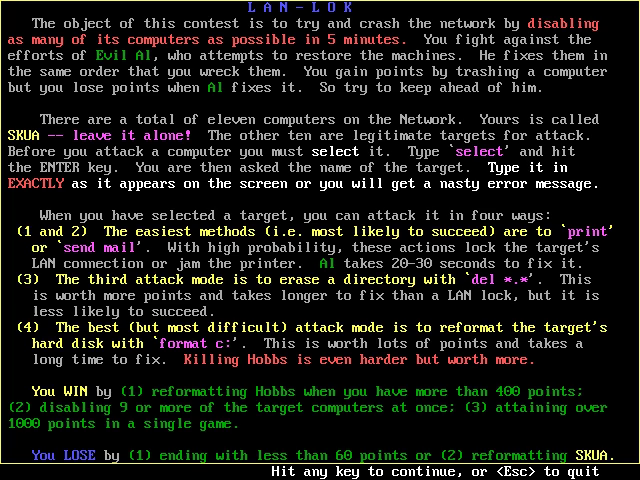
“Try to crash the network by disabling as many of its computers as possible in 5 minutes. You fight against the efforts of Evil Al, who attempts to restore the machines.”
Your goal is to inflict escalating levels of damage on ten real hostnames drawn from Palmer Station’s PCs, while not accidentally destroying your own workstation (SKUA). Evil Al repairs systems in first-in, first-out order, meaning every action you take increases the backlog he must clear. The gameplay is built around this queue, every attack creates future repairs; every repair erases your score gains.
Target Selection
Before launching an attack, you must choose a machine to sabotage. LAN-LOK requires:
- Typing
select - Pressing Enter
- Typing the exact hostname, letter-for-letter. This is important.
If you mistype the name, you’re rewarded with an intentionally obnoxious error message and must reselect. This makes hostname literacy, not just reaction time, a core skill. It’s a mechanic only someone living on a real LAN in 1991 would think to include.
Valid targets include:
lab, labstore, admin, rabbit, Calvin, Hobbs, Susi, library, ratt, and Tfive.
Your system, SKUA, is never a valid target. Formatting it immediately ends the game in failure.
Attack Methods
Once a target is selected, you choose the method of destruction. Each attack differs in speed, likelihood of success, point value, and the time required for Evil Al to fix it.
1. Print
Simulates jamming the LAN through a print job.
- High success rate
- Low repair time
- Modest points
- Quick to execute
It represents one of the most common failure modes of early network printing. (That, and PC LOAD LETTER.)
2. Send Mail
Another “soft failure” attack akin to spam or misaddressed internal email.
- Similar to Print
- Causes lightweight LAN disruption
- Low-value but fast
Both Print and Mail are low-risk ways to keep the repair queue full.
3. Delete Directory (del *.*)
A more serious attack.
- Higher points
- Lower success probability
- Longer repair time
This models accidental (or malicious) wildcard destruction, the scourge of DOS administrators everywhere. The Unix equivalent is of course rm -rf / as root, but I don't have any knowledge of Unix machines at Palmer in the 90s. We had a few SUN workstations and an SGI IRIS at McM in 1994.
4. Format Disk (format c:)
The nuclear option.
- Most points by far
- Hardest to pull off
- Very long repair time
- Failure yields nothing and wastes precious time
A special rule makes formatting Hobbs even harder but worth extra points, setting it up as the boss node of the game.
Evil Al’s Repair Queue
Evil Al fixes systems in the order you sabotaged them, a strict FIFO queue. That means:
- Soft attacks fill the queue quickly but also clear quickly
- Hard attacks slow the queue dramatically
- The entire scoring race depends on overwhelming Al faster than he can unwind your damage
Scoring
Scoring is the net of Points gained when you disable a machine and Points lost when Al repairs it.
Win Conditions
The game can end early in your favor through any of three routes:
- Successfully reformatting Hobbs while holding 400+ points
- Disabling nine or more computers at once
- Reaching over 1000 points in a single run
Lose Conditions
Failure occurs immediately if:
- Your final score is under 60 points, or
- You accidentally format your own machine (SKUA). This is not only punitive but thematically perfect, every sysadmin has a horror story of someone formatting the wrong disk.
Player History
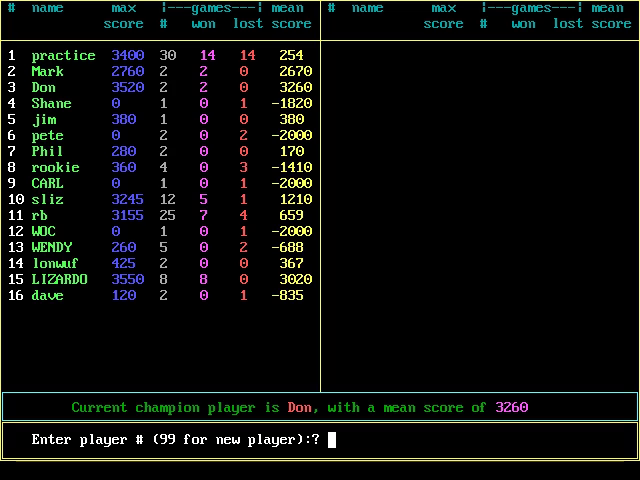
The surviving LAN-LOK score tables provide the only historical record of who actually played the game during its life at Palmer and later McMurdo Station. The list contains a mix of real first names, nicknames, and station in-jokes, entries such as Carl, WENDY, Sliz, Mark, Shane, and others.
According to Al Oxton, these names confirm that the game did not remain confined to Palmer. He carried a copy with him to McMurdo during later winters, where new players added themselves to the leaderboard. Because the game tracks wins, losses, and mean scores across sessions, the scoreboard reflects genuine sustained play rather than one-off experimentation.
I don't recognize most of the names. The authors Mark and Shane are near the top of the high scores. My personal memory is that Carl and WENDY are probably Carl and Wendy Norris, spouses who were both part of the Antarctic program long-term and were at MCM in 94/95. I had contact with them peripherally when fixing their computers and network. Yes, my own job was PCTECH, the McM equivalent to Evil Al.
Running LAN-LOK Today
Because modern 64-bit versions of Windows can no longer execute 16-bit DOS programs, LAN-LOK must be run through an emulator. The easiest and most reliable option is DOSBox, which recreates a full DOS environment independent of the host operating system.
0. Download LAN-LOK
https://alphapixeldev.com/wp-content/uploads/2025/12/Lanlok.zip
1. Install DOSBox
Download DOSBox for your platform. https://www.dosbox.com/download.php?main=1
Install it once it is downloaded.
All versions run LAN-LOK identically due to DOSBox’s consistent emulation layer.
2. Create a Game Directory
Unzip and place the LANLOK.exe executable and accompanying PLAYERS file into a dedicated folder, for example:
C:\Users\xenon\Documents\Games\LANLOKKeeping the game in its own directory ensures the working environment stays clean and prevents accidental writes elsewhere. It may be helpful to avoid spces in the path, for ease of typing within the DOSBox internal CMD emulation.
3. Mount the Directory in DOSBox
Launch DOSBox and mount the directory as a virtual drive:
mount c C:\Users\xenon\Documents\Games\LANLOKDOSBox treats this folder as drive C: inside the emulator.
4. Run the Game
At the DOS prompt inside DOSBox:
lanlok.exeThe game starts immediately. All keyboard interaction seems to work as originally intended, and LAN-LOK’s text-mode UI renders correctly at default DOSBox settings.
5. Timing Considerations
LAN-LOK is not speed-sensitive and does not rely on CPU timing loops. The default DOSBox cycles setting is sufficient. If needed, you can adjust performance with:
ctrl + F11 (slow down) ctrl + F12 (speed up)
But I haven't needed to.
6. Saving and Restoring Scores
LAN-LOK stores player profiles and scores in its working directory. As long as DOSBox mounts the same folder each time, scoreboards persist across sessions just as they did originally.
7. Optional: Create a DOSBox Shortcut
To launch the game without typing commands every time, you can preconfigure DOSBox:
Add this to your DOSBox configuration (dosbox.conf) under the [autoexec] section:
mount c C:\games\lanlok
c:
lanlok.exe
Running DOSBox will now start LAN-LOK automatically.
"Why don’t we just wait here for a while… see what happens" -R.J. MacReady
LAN-LOK is more than a forgotten DOS curiosity, it is a preserved moment in the daily life of Antarctic research stations during the earliest days of their local area networks. It captures the frustrations, humor, and personalities that shaped computing at Palmer Station as it transitioned from isolated standalone PCs to a shared (fragile) LAN.
Its mechanics are simple, but they reflect real operational challenges of the era: printer stalls, destructive wildcard deletes, catastrophic drive formats, and the constant pressure on the sysadmin to keep everything running. The fact that LAN-LOK then traveled to McMurdo and accumulated a new roster of players gives it an unusual status as a cultural artifact, an executable passed hand-to-hand by SneakerNet in one of the most remote and bizarre communities on earth.
Today, with DOS long gone from modern systems, emulation through DOSBox lets LAN-LOK run exactly as it did more than three decades ago. That makes it possible not only to preserve the software but to understand the working environment, humor, and improvisational creativity of the people who built and maintained Antarctic computing in the early 1990s.
Rediscovering LAN-LOK brings that history back into view, one hostname, one broken machine, and one frazzled sysadmin at a time, in a flashback to a time when ABEND stoked levels of terror in an Antarctica Sysadmin even greater than a Skua attacking you for your grilled cheese, or watching The Thing and The Shining back to back after station close.
So ends part one of this blog. But like The Thing, we're leaving the door open for a sequel. I've identified the likely development language as Microsoft C, likely 6.x (1989) or possibly QuickC 2.5 (1989). My intent is to try decompilation with Reko ( https://github.com/uxmal/reko?tab=readme-ov-file ) or maybe Claude-Code-guided Ghidra ( https://quesma.com/blog/chromatron-recompiled/ ) and possibly some automated analysis and fixup of the decompiled code. Then, address any 16-bit to 64-bit architecture issues, and swap out the input and graphics code to SDL. Since this is just a hobby project, I'm going to explore how much of the rework can be assisted by LLM/AI tools and coding assistants, to evaluate if this strategy is practical for real-world customer situations.
Since starting, I've spoken to Al Oxton, Mark Chappell and Shane Maloney. Anyone else who recalls playing LAN-LOK, please feel free to get in touch with me!
The path to rescuing old code and data and making it useful again is a journey, often akin to building a rope suspension bridge one plank at a time, while suspended in mid-air. Sometimes while being attacked by natives, a la Indiana Jones. Often there are interlocking chicken and egg problems, where the obvious solution won’t work because of one minor issue, which then cascades and snowballs into bigger problems. It’s not uncommon to find a bug or omission in some old tool you need to use, and when you go to fix it, you find the tool can no longer be compiled by modern toolchains, necessitating reconstruction of a side environment just to fix the problem that’s blocking you on the main endeavor. We’ve jokingly used the term “Software Archaeologist” in some contexts like these. In the modern AI era, decompilation and reverse engineering capabilities have become vastly more powerful and available.
AlphaPixel solves difficult problems every day for clients around the world. In the past we’ve done extraordinary things, like recovering deleted forensic video evidence from SD cards, having old failed hard drives refurbished to rescue critical data, reverse-engineering proprietary data formats to liberate valuable siloed information, even desoldering surface mount chips and sucking their brains out with hardware exploitation devices. We’ve worked on common and exotic architectures and operating systems and environments from the 8-bit to the 64-bit, Motorola, Intel, ARM, RISC-V, PA-RISC, DEC Alpha, Power, and microcontrollers.
If you have a difficult problem you’re facing and you’re not confident about solving it yourself, give us a call. We Solve Your Difficult Problems.